8KDVD Blog Guides Playback
Watching 8KDVD: Windows Player and Browser Fallback

8KDVD playback is a two-lane road: a Windows desktop player for the full experience, and an HTML/Chromium fallback that runs wherever you can open a local disc folder or mounted ISO. There is no consumer set-top “8KDVD deck” shipping as a mass product yet, so plan your watching setup around a PC, mini-PC, or Android device with enough GPU horsepower for VP9 Profile 2 at the resolution you pick in the menu.

Before you press Play

  • Use a Blu-ray-capable optical drive for pressed or burned BD-R/BD-XL media. A plain DVD burner will not read Blu-ray blanks.
  • Mount an ISO the same way you would any UDF volume, or copy the disc tree to a fast SSD if seek times on a flaky burner stall 8K streams.
  • Confirm the display can take the resolution you intend: 8K tiers need an 8K panel (or a downscaling path you trust); 4K and HD buttons are there for a reason.
  • Prefer a Chromium-based browser for the HTML launcher (Chrome, Edge, Chromium, Brave). Firefox may struggle with the same local media pipeline.

Windows Player (preferred path)

The Windows Player from the project’s GitHub releases is the first-class route: full-screen navigation, menu integration, and fewer browser security quirks around local file access. Install the current build, insert or mount the disc, and launch from the player rather than hunting for index.html by hand.

  1. Install the latest Windows Player release.
  2. Insert the 8KDVD or mount the ISO.
  3. Open the title from the player UI so menus and resolution switches load as authored.
  4. Pick 8K, 4K, HD, or 3D only if that button was enabled for real encodes on the disc.
  5. If video stutters, drop one resolution step before blaming the burner – decode load usually beats optical throughput as the first culprit.

HTML / Chromium fallback

On macOS, Linux, Android, or a locked-down Windows box without the native app, open the disc’s HTML menu in a Chromium browser. Launchers shipped on the disc are meant to point you at that entry page. Treat it like a local website: allow local media if the browser prompts, keep the volume mounted while you watch, and avoid “Open with…” random media players that ignore the menu layer entirely.

Android playback needs a drive or a pre-copied folder tree the device can see; USB-OTG Blu-ray enclosures vary wildly – test with a short Standard or LP encode before committing an evening to an HQ Plus master.

Practical troubleshooting

  • Black menu, no video: wrong browser engine, or the volume unmounted mid-session.
  • 8K button dead / wrong stream: that tier was never authored; use 4K/HD.
  • Audio dropouts: Opus decode is light; more often the drive is thrashing – copy to SSD and retry.
  • HDR looks flat: confirm the Windows HDR toggle and that the encode was an HDR batch from Video File Maker, not SDR.

Sample ISOs and player links live on 8kdvd.hddvd-revived.com. Smoke-test every burn on the same machine class your audience will use; “works on my edit PC” is not the same as “works on a fanless NUC with an external BD-XL.”

8KDVD Films Blog Reviews
The Tree (2019) on 8KDVD: Quiet Frames, Wide Canvas

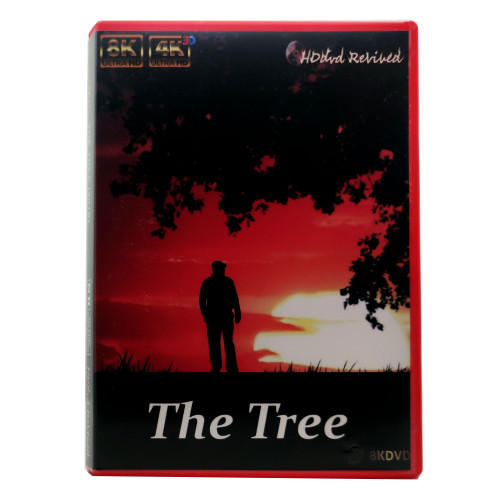
The Tree - 8KDVD Edition - retail cover
The Tree – 8KDVD Edition

Own it: Buy the 8KDVD · Stream it: Watch on 8KFlikz · Browse entertainment

A branch fills the frame before you know whose tree it is – bark in close-up, wind working the leaves like a nervous hand. No score for a beat. Just air and wood. The Tree (2019) announces itself that way and mostly refuses to shout thereafter.

This is a short, patient film about looking: a figure, a landscape, the slow negotiation between them. Plot is almost impolite to summarise. Someone returns, or remains; the tree holds the middle of the composition like a character who never needs dialogue. That is the whole invitation.

On 8KDVD the patience becomes a dare. Ultra-high resolution loves static nature photography and will punish anything soft. Here the leaves resolve into individual edges; insect motion in the mid-ground becomes accidental documentary. You start watching the film the way you watch a still that somehow kept breathing.

Silence as production value

The sound design is sparse on purpose – wind, distant traffic if any, the occasional human sound treated as interruption. Through a proper amp the quiet is not empty; it has texture. You hear the microphone’s proximity to foliage, the tiny scrape of cloth when someone shifts. Lesser formats would bury that under compression hiss. This one lets it sit.

Colour stays naturalistic. Greens are green, not “cinematic teal.” Skin, when it appears, looks lived-in rather than graded for a trailer. Whoever supervised the transfer understood that the film’s entire argument is against spectacle, and they did not smuggle spectacle in through the back door of the encode.

Hold on a mid-shot of the trunk long enough and you start inventing narrative you were not given – which may be the film’s quiet trap. The camera does not cut away to explain. 8KDVD’s stable encode means those holds never dissolve into compression soup, so your impatience (or your calm) is entirely your own problem. That is rarer than it should be on premium discs stuffed with motion graphics.

Why put a whisper on a loud format?

Fair question. 8KDVD’s red-box swagger usually attaches to genre fireworks and restoration flexes. The Tree is neither. What the disc offers is simply room – horizontal room, tonal room – for a piece that was always meant to be contemplated rather than consumed. Bitrate stays high through long holds; no mosquito noise crawling across the sky gradients.

I watched it once standing, once seated, which is a ridiculous test and also the right one. Standing, you notice how often the frame wants you to lean in. Seated, you notice how little it needs you to. That tension is the review.

If you came for plot machinery, eject early and no hard feelings. If you came to see whether a quiet short can occupy a format built for bombast, leave the case open on the shelf afterwards. The plastic still looks slightly embarrassed to be hosting something this still. Good.

Magazine columns used to end with a shopping tip. Mine is simpler: dim the bias lighting, kill the phone, and let a tree occupy more pixels than most blockbusters spare for their heroes’ faces. The format can take it. So, occasionally, can you.

Physical disc: The Tree – 8KDVD Edition. Streaming: 8KFlikz title page.

Also available from us in other formats:

8KDVD Blog Format Overview Guides
What Is 8KDVD? A Format Field Guide

8KDVD is an offline ultra-high-definition disc format from HD DVD Revived. It stores feature video as VP9 Profile 2 with Opus audio on ordinary Blu-ray media imaged as UDF 2.60, and it drives navigation with HTML menus that open in a Chromium-class browser or the dedicated Windows player. Think of it as a physical carrier for 8K (and lower-resolution fallbacks), not a new laser standard and not a streaming app squeezed onto plastic.

What sits on the disc

A finished 8KDVD is a data disc: encoded WebM-style bitstreams, menu HTML/JavaScript, platform launchers, and artwork assets laid out so a PC or Android box can mount the volume and start the menu. The volume format is UDF 2.60 – the same family Blu-ray authoring tools already know – so ImgBurn and similar burners can write 25 GB or 50 GB BD-R, or larger BD-XL blanks when the project needs the headroom.

  • Video: VP9 Profile 2 (SDR or HDR10 batches from Video File Maker).
  • Audio: Opus, muxed with the video tier.
  • UI: browser-based menus built in Menu Maker, with resolution switches (8K / 4K / HD / optional 3D) when those tiers exist.
  • Playback: Windows app first; HTML/Chromium fallback on Windows, macOS, Linux, and Android.

Encode profiles in one line

Authoring targets four named profiles – HQ Plus, HQ, Standard, and LP – which trade bitrate and runtime against disc capacity. HQ Plus is the short premium 8K tier; Standard is the practical “feature film on 50 GB-class media” setting; LP packs longer programmes onto 25 GB blanks. Pick the profile before you encode; the menu should only advertise resolutions you actually built.

How it differs from Blu-ray and Ultra HD Blu-ray

Commercial Blu-ray and UHD Blu-ray use MPEG-family video, proprietary menu systems, and licensed player stacks. 8KDVD deliberately uses open codecs and a web menu layer so indie and remaster projects can ship without a Hollywood authoring suite. There is no dedicated living-room 8KDVD deck yet; the published path is the Windows player plus the HTML launcher. Hardware makers can integrate the same menu model later – the navigation was designed with that in mind – but today you plan for a PC, mini-PC, or Android player with a Blu-ray-capable drive (or a copied folder/ISO).

Physical presentation

Retail and demo titles use a red, DVD-sized case so the format reads at arm’s length on a shelf. Photoshop box templates and sample ISOs live on the official project site. Licensing for low-budget and free/CC work is intentionally light; check current terms on 8kdvd.hddvd-revived.com before you brand a commercial release.

Tool chain at a glance

  1. Video File Maker – batch SDR/HDR encodes into the profile set.
  2. Menu Maker – HTML navigation, chapters, resolution buttons.
  3. ImgBurn (or equivalent) – UDF 2.60 image or burn; BD-XL when capacity demands it.
  4. Windows Player / Chromium launcher – verify before you mail discs.

The older all-in-one 8KDVD Maker wizard still exists for demos, but new titles should follow Video File Maker → Menu Maker → ISO. For living docs, profiles, and downloads, start at the official 8KDVD site and work outward from the authoring guide rather than inventing a parallel workflow.

8KDVD Films Blog Reviews
A Boy and His Dog on 8KDVD: Heat, Dust and a Mean Little Future

A Boy and His Dog - 8KDVD Edition - retail cover
A Boy and His Dog – 8KDVD Edition

Own it: Buy the 8KDVD · Stream it: Watch on 8KFlikz · Browse entertainment

Don Johnson’s face, mid-1970s, fills half the screen before the titles settle – sunburned, cunning, already tired of the joke. Beside him, somewhere off-mic in the mix, Blood the dog is thinking three moves ahead. That telepathic rasp still cuts through interlocuted dust better than most human villains of the era.

L.Q. Jones’s A Boy and His Dog (1975) remains one of the meaner post-apocalyptic comedies American cinema bothered to finish. Vic scavenges the wasteland with his canine partner; they find a girl; the underground “civilisation” waiting below is worse than the dirt above. Three sentences and you have the map. The rest is attitude and sand.

8KDVD does not soften the film. It enlarges the grit. You see the weave in Vic’s shirt, the powder on every horizon, the cheapness of the underground sets that somehow makes them more convincing. Heat haze at the frame edges used to smear into mush on VHS; here it hangs as a proper optical event.

A soundtrack that still bruises

Tim McIntire’s score – and Blood’s voice work – arrive with a presence the old laserdisc never quite managed. The dog’s commentary sits slightly forward in the soundstage, which is correct: Blood is the brains of the outfit. When the film drops into the Topeka cult’s pastel hell, the audio opens up just enough to make the ritual scenes feel staged rather than merely filmed, which they were.

Colour grading on this encode leans warm without turning the desert into a postcard. Flesh stays a little raw. Night sequences keep their crushed blacks instead of being lifted into digital fog. Someone, bless them, resisted the urge to “HDR the apocalypse.”

Jones shoots the wasteland like a man who knows the budget ends at the ridge line. 8KDVD makes that thrift legible without mocking it: cardboard rocks stay cardboard, but the light on them is properly nasty. Underground Topeka, with its forced cheer and ceremonial nonsense, gains a sickly pastel clarity that televisions of the rental era never managed. You see why Vic should have stayed in the dirt.

Case, disc, and the cult problem

The 8KDVD package treats the title like a proper catalogue entry rather than a novelty reprint, which matters for a film that spent decades ping-ponging between bootlegs and grey-market DVDs. Menu navigation is plain. Bitrate holds through the underground chase work; no banding on those dreadful fluorescent corridors.

What you cannot buy with resolution is the film’s ethics, such as they are. Jones and Harlan Ellison’s source material never asked to be cuddly, and the ending still lands like a slap delivered with a smile. Watching it this large does not redeem Vic. It only makes his grin harder to look away from.

Specialist shops used to keep this one behind the counter next to the other “problem” titles – not banned, just eyed. The red box does not civilise it. It only confirms that mean little futures deserve the same shelf dignity as prestige restorations, provided you can live with what is on the platter.

Put another way: if your idea of future shock involves tasteful desolation and noble survivors, stay upstairs with the dust. Down here, the joke was always on you.

Physical disc: A Boy and His Dog – 8KDVD Edition. Streaming: 8KFlikz title page.

Also available from us in other formats:

8KDVD Films Blog Reviews
Elephants Dream on 8KDVD: Open Source Ambition in the Red Box

Elephants Dream 8KDVD Boxed Edition - retail cover
Elephants Dream 8KDVD Boxed Edition

Own it: Buy the 8KDVD · Stream it: Watch on 8KFlikz · Browse entertainment

The first thing you notice is the red. Not metaphorically – the actual plastic of the 8KDVD case catching the lamp like a stop light someone forgot to switch off. Inside: a short that once lived on BitTorrent trackers and festival hard drives, now encoded as if it were a studio prestige title.

Elephants Dream (2006) still looks like what it is – Blender Foundation’s open-source flex piece, a twenty-minute crawl through a mechanical underworld that never quite explains itself. Proog and Emo argue. Pipes drip. Something vast hums behind corrugated walls. That is enough plot for anyone who remembers downloading it at dial-up speed and squinting at a 640×360 window.

On 8KDVD the joke is almost cruel. Surfaces that were meant as proof-of-concept CGI suddenly have grain you can invent. Metal seams resolve into tiny bevels. The air between characters takes on a volumetric thickness that the original release only hinted at. You are watching a student project with the bitrate of a Bond title, and the disc does not care.

Ambition, openly admitted

What survives, and what the ultra-wide frame weirdly flatters, is the film’s stubbornness. This was never meant to be a story so much as a stress test – can volunteers, free tools, and a shoestring render farm produce something that holds a darkened room? In 2006 the answer was a cautious yes. On this disc the answer is louder.

Bass notes in the industrial corridors have weight now. Footfalls land with a physical slap the old AC3 track only sketched. When Proog’s voice cracks into lecture mode, you hear the room around him, not just the dialogue stem. For a film built on donated labour, that clarity feels almost indecent.

Watch the early tracking shot past those ribbed tunnels again. On old progressive downloads the geometry used to swim; here the perspective holds, and you notice how often the animation cheats scale for mood rather than physics. That cheat reads as style now, not limitation. Emo’s petulance, Proog’s missionary zeal – both faces take the resolution without melting into uncanny-valley plastic. They still look like ambitious CG, which is honest.

The red box problem

Specialist formats attract specialist buyers, and Elephants Dream on 8KDVD will mostly reach people who already know the punchline: open source cinema as artefact. Fair enough. The case art leans hard into the original orange-and-steel branding; the menu is mercifully brief. Playback, on a compliant deck, is rock-steady – no stutter on the long tracking shots through the Machine’s guts, which is where lesser encodes used to hiccup.

Is it essential? Only if you care about the weird history of how digital animation left the studios and wandered into forums. For everyone else it is twenty minutes of handsome unease, followed by the odd satisfaction of ejecting a disc that once would have been a ZIP file.

Collectors will argue about whether shorts belong on premium physical formats at all. Ignore them. Runtime was never the point of a disc the way it was never the point of a 45. You buy the spinning object because the film mattered enough to keep in a case you can trip over.

I put it back in the red case and thought of the first time I saw it on a CRT laptop in a student kitchen. Same film. Different object. The object wins by a nose.

Physical disc: Elephants Dream 8KDVD Boxed Edition. Streaming: 8KFlikz title page.

Blog CBHD Guides Open Questions
CBHD Open Questions and Confirmed Facts

What the research passes treat as confirmed

After multiple independent compilation passes, the following statements are treated as established rather than speculative:

  • Professional CBHD authoring and professional CBHD verification existed (Memory-Tech/CBC/UOD production; DCA China HD verifier documentation).
  • UDF was used; CBHD had its own physical modulation (4-6 FSM replacing HD DVD 8-12 ETM).
  • Commercial CBHD players, proprietary optical pickups and CBHD-specific chipsets existed (Shinco and TCL production models; pickup and Novatek patents).
  • CBHD/BD optical compatibility was actively engineered (freeform objective-lens patent; multi-format pickup discussion).
  • Recordable CBHD was technically contemplated; commercial CBHD was primarily pressed/read-only (dye patent; AACS LA P/R categories; no shipped CBHD-R ecosystem found).
  • DKAA existed; AACS was used for international content; CETC navigation existed; AVS/DRA were part of the format.
  • CBHD was not normally compatible with HD DVD players.

Still unresolved – specifications and DRM

  1. Exact CBHD Book 2 and Book 3 specifications; complete CETC authoring specification.
  2. Complete DKAA specification, key architecture and key files. Expansions of the name disagree (“dual-key” vs “Data Key Authorization Access”); no pass cites a DKAA specification document; no DKAA patent numbers were located.
  3. GB/T, SJ/T or CY/T standard number for CBHD as a whole (AVS and DRA have numbers; the disc format does not in any pass).
  4. The actual FSM 4-6 patent (an OMNERC RLL patent exists but is not confirmed as commercial FSM).

Still unresolved – software and imaging

  1. Commercial authoring application names; encoder names and versions; CBHD muxer and premastering software (known to have lived at CBC; binaries not found).
  2. CBHD emulator; CBHD PC playback software (absence not fully proven).
  3. Firmware archive, firmware file formats and update history (THBD-1008 Spansion flash is a dump target only).
  4. An actual CBHD disc image; directory dumps; MediaInfo logs from real discs.
  5. Whether burned DVD/HD DVD-R media with a CBHD folder structure plays on real CBHD players (Gemini pipeline vs FSM physical argument).

Still unresolved – catalogue and hardware inventory

  1. Complete movie catalogue, catalogue numbers (ISRC/版号) and disc IDs.
  2. Complete player chipset inventory; service manuals; board photographs for every model; CBHD pickup part number.
  3. Commercial CBHD-R media and recorder.
  4. Any successful HD DVD → CBHD or CBHD → HD DVD conversion.
  5. Relationship between Shinco HD-3700 (HiFi demonstrator, July 2010) and HD-3700U (UTI hybrid player).
  6. Primary-source confirmation for TCL THBD-1038 feature set beyond secondary encyclopaedia entries.

Conflicts between passes that remain open

Topic Tension
PC HD DVD drives reading CBHD sectors Claimed workable vs FSM/channel hardware requirement; no published test
Home-burned DVD+R DL playback Gemini “works on HD-3700U/THBD-1008” vs no documented successful case elsewhere
Directory layout CBHD_TS/.AVS model vs EVOB/HD DVD Book 3 model
Early disc codecs “Exclusively AVS” vs early VC-1/AVC likely before Sep 2009
Region coding Undocumented / HD DVD-like free vs China-locked
Shinco monthly sales “Under 11,000” vs “on the order of 11,000” CHDA-sourced summaries
3:1 CBHD vs Blu-ray sales Single GOME store / promoter figure vs later CMM decline data

Highest-value next artefacts

  1. One inexpensive domestic CBHD disc plus sector image.
  2. Working Shinco CBHD-9100 and TCL THBD-1008 for behavioural comparison.
  3. Pickup label photos and Novatek/other chipset identification.
  4. NOR flash dump from THBD-1008 (and any Shinco dump).
  5. DCA Class A verifier with China HD configuration.
  6. CBC / Memory-Tech / UOD authoring or premaster samples.
  7. AACS CBHD Pre-recorded 0.90 book plus any DKAA fragment.
  8. std.samr.gov.cn / 新闻出版 search for CY/T CBHD documents.
  9. Full AVSForum master thread scrape while pages remain reachable.
  10. Wayback walks of shinco.com news/product trees and chdia.org.cn.

How to read the rest of this series against the open list

Format-at-a-glance and technical posts state physical parameters from the CHDA technical page with confidence. History and market posts carefully mark single-store sales myths. Codec posts separate what FFmpeg can decode from what DKAA still blocks. Hardware posts limit commercial models to the documented Shinco and TCL six, noting prototypes separately. Firmware and home-authoring posts present conflicting arguments side by side rather than picking a winner without evidence. Catalogue and buying posts refuse inflated 1,000-title claims and empty eBay searches as proof of total absence on Chinese C2C apps.

The open-question list is the research agenda. Confirmed items are the floor. Everything between-especially FSM vs burnable UDF, DKAA internals, and a real directory dump-decides whether CBHD reconstruction stays a literature project or becomes a playable archive.

Method notes for the next research cycle

Treat single-store sales myths, promoter-sourced 30/10/60 splits and alliance 1,000-title targets as claims with provenance, not as measurements. Treat CHDA physical parameters (0.204 μm pits, 0.40 μm track pitch, NA 0.65, 36.55 Mbps 1×, 28 Mbps max video) as higher-confidence because they come from the archived technical page. Treat Gemini-only pipelines and directory trees as hypotheses until a disc image confirms or falsifies them. Treat “no PC decoder found” as an open search, not a mathematical proof of absence.

When two passes conflict, publish both rows in the lab notebook rather than averaging them into a false consensus. FSM versus ATAPI sector-read, CBHD_TS versus EVOB, exclusive-AVS versus early-VC-1, and China-locked versus region-free are the four conflicts most likely to waste months if silently resolved the wrong way.

Success criteria for closing questions

  • Book 2/3: page images or PDFs with identifiable revision strings.
  • DKAA: patent numbers plus at least one key-file format description.
  • Authoring: named executable or installer from CBC/Memory-Tech with version.
  • Firmware: hashed NOR dump from THBD-1008 with readable strings list.
  • Disc image: full sector image plus UDF tree listing and MediaInfo.
  • Home burn: dated photo/video of a named burned disc playing on a named player model.
  • Catalogue: 版号 list or photographed spines covering >100 unique retail SKUs.
  • Pickup: part number photographed on a commercial Shinco or TCL mechanism.

Until those criteria trip, the series should keep hedging language. Confirmed facts in section one are the floor you can build tooling on; everything else is scaffolding. The corrected history-from 2005 WG-11 proposal through FSM/CETC/AVS engineering, Memory-Tech production, April 2009 launch, GBAX UK import, ~100-title plateau and 2011 collapse-is solid enough to motivate the hunt. The open list is what the hunt still owes the archive.

Hardware inventory gaps include service manuals for every commercial model, board photographs beyond the THBD-1008 excerpt, confirmation of THBD-1038 features from primary Chinese sources, and clarification whether Shinco’s HD-3700 HiFi demonstrator equals, variants, or differs from the HD-3700U UTI hybrid. Prototype photography of CBHD-9000 and Tongfang CBHD-0002 should stay labelled prototype, not quietly merged into the six-player commercial set.

Standards gaps include the missing whole-format GB/T or CY/T number, the true 4-6 FSM patent (as opposed to the nearby OMNERC RLL grant), and DKAA’s patent family. Software gaps include emulator existence, PC playback apps, and named muxer versions. Imaging gaps include any public sector dump. Compatibility gaps include any proven cross-flash and any proven burned-disc playback on named hardware. Closing any three of those clusters would materially change what “CBHD revival” can mean in practice.

Community-source gaps double as open questions: uncleared Tieba and Douban groups may hold directory screenshots; unrecovered GBAX product pages may hold UK bundle lists; unlocated BOC licensing pages may hold royalty schedules. The open list is therefore not only laboratory work-it is also archival web work against rotting 2009 HTML. Prioritise artefacts that unlock multiple questions at once: one disc image tests filesystem, codecs and DRM; one firmware dump tests CETC and key handling; one DCA verifier install tests Book 3 assumptions without needing the lost authoring GUI.

Ordering the hunt

If resources allow only three purchases, buy one domestic disc, one Shinco CBHD-9100, and one TCL THBD-1008. If resources allow only one engineering week, dump the THBD-1008 flash and photograph both pickups. If resources allow only web time, finish AVSForum page captures and std.samr.gov.cn searches for CY/T CBHD documents. Those three tracks-media, firmware, standards numbers-unlock the largest number of dependent questions on the unresolved list. Home-authoring experiments and cross-flash fantasies can wait until the floor artefacts exist.

Revisit this open list after each new artefact; strike items only when the success criteria above are met with citeable files.


Further reading on historic video formats

If you want to learn more about historic video formats, get The History of Physical Video Formats from the Frontier by Stephen Driver on Amazon:

Blog CVD Guides Open Questions
CVD Open Questions and Confirmed Facts

Separating the known from the missing

China Video Disc (CVD) research is uneven: some commercial and technical facts are multiply attested, while neighbouring questions that collectors naturally ask-exact model lists, named titles, full standard texts-remain open. Separating the two is the point of this post. Confirmed items below are those the located 1998 Chinese press, C-Cube SEC filings, VCDImager documentation and DVD-Video references support. Unresolved items are framed as questions, not as guesses. Source conflicts that cannot yet be measured are kept as open disagreements rather than collapsed into a single “settled” story.

Confirmed facts

  1. Launch date and place. CVD was launched on 9 June 1998 in Shanghai with a jointly drafted industry standard (Wenzhai Bao).
  2. C-Cube decoder timing. C-Cube sold a CVD decoder from Q2 1998 and described it as Chao Ji VCD-compliant by Q3 1998 (SEC filings).
  3. National Super VCD standard. SJ/T 11196-1998 was announced on 29 September 1998, took effect on 1 November 1998, and made two technical changes towards CVD (Guangming Daily). What those two changes were is not yet recovered from the full text.
  4. Player mechanism and decoder camps. Contemporary Guangming Daily reporting associates CVD players with Philips 2× mechanisms, CD7 servo and C-Cube decoders, and SVCD players with Sony mechanisms and a reported ESS/Shinco decoder.
  5. 5.1-channel announcement. A 5.1-channel CVD scheme had been announced by November 1998 (Guangming Daily).
  6. Shared INFO system ID. CVD and SVCD share the “SUPERVCD” INFO system ID; video width (352 versus 480) is the reliable discriminator (VCDImager).
  7. Subtitle format. CVD-style subtitles are a distinct, non-IEC format, reverse-engineered in VCDImager’s cvd-subtitles documentation.
  8. MPEG-2 legality at 352 width. 352×480/576 MPEG-2 is DVD-legal video (DVD-Video / Wikipedia summaries of the DVD-Video constraints).

These eight points already constrain preservation work. A disc labelled only by the SUPERVCD system ID is not automatically “SVCD” in the 480-wide sense; width measurement is mandatory. Subtitle streams cannot be assumed to be standard OGT/IEC without inspection. Hardware identification should ask for Philips-versus-Sony mechanism photos and C-Cube-versus-ESS/Shinco chip markings because period reporting treated those as camp markers. C-Cube’s Q2-Q3 1998 SEC language ties the commercial chip story to Chao Ji VCD branding, which matters when Western sellers list “Chaoji” rather than “CVD.”

What “confirmed” does not mean

Confirmed does not mean complete. The 9 June Shanghai launch is attested; the full enterprise-standard text from that launch is not. SJ/T 11196’s effective date is attested; its full text and the exact “two technical changes towards CVD” are not. Mechanism/decoder camps are attested in contemporary comparison reporting; every individual 1998 retail SKU has not been inventoried. The 5.1-channel scheme was announced; shipping status of 5.1 CVD titles is unproven here. Shared SUPERVCD identity and 352-versus-480 discrimination are tool-supported facts; they do not invent a title list. DVD-legal video at 352 width explains why hobbyists could remux to DVD without re-encoding pictures; it does not prove every Western DVD player accepts CD-based CVD discs.

Still unresolved

The open list is long because the format’s paper trail is thin outside newspaper summaries and hobbyist reverse engineering:

  • Full text of the June 1998 CVD enterprise standard. Without it, “jointly drafted industry standard” remains a chronological fact rather than a readable technical specification.
  • Full text of SJ/T 11196-1998, and a precise account of the “two technical changes towards CVD” named in Guangming Daily.
  • Whether 1998 CVD allowed 480-wide video. Guangming Daily says CVD suited 2/3 D1 as well as 1/2 D1-language that would permit 480-wide as well as 352-wide material-but that claim sits in tension with later hobbyist practice that treats 352-wide as the CVD hallmark. Keep both notes; do not collapse them.
  • The exact CVD disc identifier and the mechanism of 1998 “interference codes” reported in the compatibility war.
  • Private_stream_1 sub-IDs for CVD-style subtitles. 0x00-0x03 is assumed in tooling discussion, not verified against a corpus of pressed discs.
  • Model names and chip markings of 1998 CVD players beyond the reported Jinzheng N100/N300. Brand-level coverage (Jinzheng, Aido, SAST and others) is far ahead of SKU-level coverage.
  • C-Cube CVD decoder part number(s) and datasheet. SEC filings confirm product timing and Chao Ji VCD compliance language; the discrete part numbers and electrical documentation remain missing.
  • Any named commercial CVD title, its publisher and 版号. Aggregate “several hundred titles” claims exist; individual spines do not, yet.
  • Identity of “Xiamin Solid” / “Xiamen Solid.” The name appears in C-Cube’s customer list and Western summaries as an unresolved entity label.
  • Whether current VCDImager warns or refuses on 352-wide SVCD input-a tooling behaviour question that affects how researchers classify homemade discs.
  • Real CVD compatibility rates of Western DVD players. Community claims range from roughly 30% of NTSC players to effectively 100% of SVCD players. Those figures disagree and must stay open.
  • Chipset support lists for later DVD platforms (Zoran, MediaTek, Sunplus) with respect to CVD playback.
  • Whether the “CVD 2000 project” (¥200 million) announced in November 1998 actually produced discs.

How to use the open list

Each unresolved item suggests a different next archive. Enterprise and SJ/T texts point at standards libraries, CNKI, and ministry or industry-body reprints. The 480-wide ambiguity points at recovering Guangming Daily’s full technical comparison table and measuring any surviving disc. Interference codes point at Wenzhai Bao’s late-1998 compatibility reporting and at physical discs that fail selectively on rival camps’ players. Subtitle sub-IDs require bitstream captures from labelled CVD discs, not more assumption. Model and chip work requires seller photographs, board shots and possibly Internet Archive captures of c-cube.com product pages from 1998-2000. Title and 版号 work requires Kongfz/Xianyu disc photography. “Xiamin/Xiamen Solid” needs Chinese-language company and press search against C-Cube’s named customer list. Compatibility percentages need structured playback tests across known SVCD-capable decks rather than another forum anecdote. CVD 2000 needs follow-up in late-1998 and 1999 industrial reporting.

Open disagreements to preserve

Two conflicts deserve explicit preservation as disagreements rather than premature synthesis. First, video width: tool culture and many Western guides treat 352-wide MPEG-2 as the CVD signature, while 1998 Guangming Daily language about suitability for 2/3 D1 as well as 1/2 D1 leaves room for 480-wide CVD. Second, Western player compatibility: one community tradition cites low NTSC success rates near 30%, another treats SVCD-capable players as effectively universal CVD players, and some VideoHelp posters reported never finding a working NTSC CVD machine at all. Until measured disc samples and controlled player matrices exist, both conflicts remain research status, not settled lore.

A third soft disagreement sits behind launch-maker rosters already discussed elsewhere in this series: Wenzhai Bao’s five-firm list, Jinzheng’s seven-firm “first batch,” Baidu Baike variants and Western summaries that name “Xiamen Solid” differently. Those are kept open in the history post; they reappear here only to note that “confirmed launch on 9 June 1998” does not yet mean “confirmed single maker list.”

A working research posture

The confirmed set is enough to begin serious collecting and dumping: know the launch date, know C-Cube’s 1998 decoder window, know SJ/T 11196’s calendar, know the Philips/C-Cube versus Sony/ESS-Shinco hardware axis reported in 1998, know that 5.1 CVD was announced, know that SUPERVCD identity is shared and width discriminates, know that CVD subtitles are a special case, and know that 352-wide MPEG-2 is DVD-legal video. The unresolved set is enough to stop false catalogue inflation: no standard PDFs in hand, no decoder datasheet, no named title, incomplete model list, unverified subtitle IDs, unsettled width and compatibility stories, and an unverified ¥200 million disc project.

Future posts in this series should promote an item from “unresolved” to “confirmed” only when a primary document, a measured disc, or a photographed SKU supports the move. Demoting a “confirmed” item should be equally explicit if a better primary source contradicts the newspaper or tool summary used here. CVD history will not be completed by smoothing over gaps; it will be completed by filling them with the same discipline that already secured the eight facts above.


Further reading on historic video formats

If you want to learn more about historic video formats, get The History of Physical Video Formats from the Frontier by Stephen Driver on Amazon:

Blog CBHD Community Sources Guides
CBHD Community Sources: Forums, Press and Reviews

Why forums and trade press matter more than product pages

Manufacturer support sites for 2009 CBHD players are mostly dead. The densest surviving primary material sits in 2009-2011 forum threads and Chinese/Japanese trade press. AVSForum pages returned HTTP 402 when fetched directly in one research pass, so details below combine search snippets with cited URLs that still resolve when logged-in browsers or archives cooperate.

Forum threads

Thread Date Unique content
AVSForum – Chinese CBHD player master thread (with pics) 2009-2010 TCL service-manual block diagram and chip IDs; A30/A35 comparison; import experience; Taobao disc prices; CHDA Guangzhou plans; Joyo-Amazon/Dangdang; GOME/Suning deals
AVSForum – China CBHD Player User Reports ~May 2009 THBD-1008 unboxing; Toshiba-like menu; three launch models with photos (THBD-1008, Shinco CBHD-9000, THTF CBHD-0002); bundle list
AVSForum – China turns HDDVD into CBHD 2008 Early marketing; firmware debate; Richard Paul’s physical-incapability view
AVSForum – China officially released CBHD players 22 Apr 2009 Translation of Sina Tech launch article
LDDb – CBHD: The forgotten Blu-Ray competitor – Owner experience with Shinco HD-3700U, quirks, directory behaviour
LDDb – second CBHD thread – Sampler bundles, sourcing, trading
What Hi-Fi – Can I play Chinese CBHD in HD DVD player 16 Oct 2009 Confirms incompatibility
DVD Talk – Will China’s HD DVD format work in domestic players 2008 Compatibility debate
Reddit r/HDDVD – HD DVD Emulator Firmware – HD DVD firmware context (not CBHD dumps)

Key URLs (avsforum.com threads 1150473, 1149496, 1059383, 1141114; forum.lddb.com topics 10789 and 11813; forums.whathifi.com thread 35580; forum.dvdtalk.com thread 525341).

Reviews and Chinese trade press

  • PConline Shinco CBHD-9100 review, 5 Jul 2009 – five pages, 54 photos, spec table (Sina mirror 4 Jul 2009).
  • 电脑报 2009 No. 30 – hands-on; USB 1080p and subtitles; ¥2,999 (sciencenet repost).
  • itavcn CBHD-9100 spec page, May 2009.
  • ZOL THBD-1008 menu/interface reviews, Jun 2009; CBHD-9100 price page ¥2,580.
  • Sina Tech TCL CBHD test (1 Jun 2009); industrialisation piece naming three format changes and FSM “to add Chinese patents” (3 Apr 2009).
  • Yesky CBHD-3800 parameters, ¥2,980.
  • pjtime buyer’s guide, CBHD-9100 review, THBD-1008 coverage, market comparisons, Dec 2009 price cuts, Jan 2010 CBHD vs BD, 2 Jul 2010 3D launch, 16 Jun 2011 CMM data (4.2% blue-laser share).
  • av269 15 Jan 2010 – 150 vs 1,800 titles; 50,000 players; regional prices.
  • Tencent Tech 5 Jul 2010 – one 3D title; ~100 titles; TCL exit.
  • cnBeta Warner support (Mar 2009); ~80 CAV Warner titles and ¥28 discs (2010).
  • eetrend Apr 2010 – Suning sales; National Geographic set.
  • big-bit / fx361 / CCCME / Chinatimes – Warner plans, 30/10/60 sales claim, 中录 exclusivity note, 3D push, launch plans.
  • Sina News Dec 2011 – Shinco blue-disc investment “met a cold market.”

International press and blogs

  • Nikkei xTECH (4 Aug 2009) – price economics (¥55 vs ¥175 BD vs ¥60 pirated BD).
  • Diamond Online – retail observation (writer never saw physical CBHD software shops).
  • ITmedia field report (Oct 2009) – Suning visit; Slumdog Millionaire as CBHD-only vs HD DVD.
  • ASCII retrospective (2013) – format gone; author estimated ~25 dedicated titles across EVD/CBHD experiments.
  • New Atlas, CDRInfo (launch, AACS, CHDA structure, HD DVD China logo), Gizmodo (modulation comment), Tom’s Hardware, Sound & Vision, The Guardian (31 Jul 2008), What Hi-Fi (CBHD-3D/HiFi), DFC Intelligence (28 Jul 2008, ~$8 royalty), See You Next Wednesday (28 May 2009 hack hopes), diit.cz (European import), dvd-and-beyond (Warner/CAV Warner).
  • Gigazine (27 Oct 2009) – TCL internals as Toshiba HD DVD hardware.

Video

YouTube clip titled along the lines of “After many years, finally CBHD Chinese Blue High …” (video id VzRO4VhM1Bw) is cited in secondary research. Bilibili searches for CBHD teardowns in one pass returned only an unrelated Shinco VCD changer video.

Manufacturer and alliance URLs to archive-hunt

  • shinco.com historical news_id pages 312, 361, 367 (Warner support, Universal support, product launch) – paste into Wayback.
  • chdia.org.cn (e.g. /dongtai002.html) – alliance site, likely offline.
  • tcl.com 2009-2010 product captures; current manual downloaders unlikely to list THBD-1008.
  • Memory-Tech 20090323 and 20090430 CBHD announcements.
  • AACS Spec CBHD Prerecorded 0.90 (7 Oct 2008) PDF cited by ja.wikipedia.

Not yet searched or found empty

Baidu Tieba (CBHD吧, 蓝光吧, 新科吧), Chiphell, hifidiy, 影音极客, hifi.com.cn, AV前线, Zhihu, Douban groups, Doom9, videohelp, Myce/CDFreaks, AV Watch, Phile-web, Reddit beyond r/HDDVD, Youku, Xigua, Douyin and Weibo remain lightly touched or empty in the passes. Empty search results are not proof of absence-especially on Tieba and Douban.

For reconstruction work, prioritise: AVSForum master thread page 5 (TCL 维修手册 excerpts), LDDb HD-3700U owner posts, PConline/ZOL photo reviews, Memory-Tech press releases, and Wayback walks of shinco.com/chdia.org.cn. Those sources carry chip IDs, bundle lists, menu trees and pricing that product databases dropped years ago.

How to work the archive without the live web

Start with PConline’s five-page CBHD-9100 review and ZOL’s THBD-1008 hands-on pieces for UI photography and measured behaviour. Add pjtime’s 2009-2011 market series for price cuts, 3D launch notes and the June 2011 CMM statistic that blue-laser players were only 4.2 percent of 2010 disc-player unit sales. Tencent’s 5 July 2010 article pins TCL’s exit, the ~100-title plateau and the single 3D title. av269’s 15 January 2010 Guangzhou comparison supplies the 150-versus-1,800 title claim and the ~50,000 player estimate.

Japanese and English field reporting fills gaps Chinese marketing omitted: ITmedia’s Suning visit, Nikkei xTECH price economics, Diamond Online’s observation that software was online-only for one writer, Gigazine on TCL’s Toshiba internals, ASCII’s 2013 retrospective, and diit.cz on European arrival. CDRInfo’s cluster on CHDA structure, the HD DVD China logo and AACS mentions remains useful for standards chronology.

Forum triage order

  1. AVSForum master thread-especially page 5 service-manual excerpts.
  2. AVSForum User Reports-unboxing, CBHD-9000/CBHD-0002 photos, bundles.
  3. LDDb CBHD threads-HD-3700U quirks and trading.
  4. What Hi-Fi and DVD Talk-compatibility negatives.
  5. 2008 “China turns HDDVD into CBHD” thread-firmware debate context.

Manufacturer URLs to feed into Wayback include shinco.com news_id 312, 361 and 367, chdia.org.cn dynamic pages, Memory-Tech’s March/April 2009 announcements, and the AACS CBHD Pre-recorded 0.90 PDF cited by Japanese Wikipedia. Empty results on Tieba, Chiphell, Doom9 and Bilibili teardowns are unfinished searches, not closed cases. Budget time for logged-in AVSForum browsing because anonymous fetches returned HTTP 402 in one research pass.

Additional press anchors worth downloading before links rot further: cnBeta Warner-support and industrialisation interviews with Tian Yujing; big-bit pieces on Warner’s 100-title plan and the August 2009 sales-lead claim; Chinatimes launch planning; Sina’s December 2011 Shinco “cold market” post-mortem; What Hi-Fi’s CBHD-3D/HiFi coverage; DFC Intelligence’s 28 July 2008 royalty note; See You Next Wednesday’s May 2009 hack-hope blog; New Atlas and Tom’s Hardware launch notices. Each supplies a dated claim you can cross-check against CMM and Tencent later data.

Video remains thin: one YouTube clip is cited; Bilibili teardown searches misfired on unrelated Shinco VCD changers. Offering rewards in preservation Discord/QQ groups for phone video of menu trees and disc loads may outperform web search. When AVSForum returns payment walls, use search-engine caches and the Wayback Machine on thread URLs ending in page-4 and page-5.

pjtime’s Shinco brand news index still lists the 3 March 2010 CBHD-3800/HD-2100 article; av-china.com and Headphone Club covered HiFi/3D launch events in July and September 2010; CCCME summarised the 3D patent-pool working group. Launch reporting from a&s, Hualu and hxzg.net on 22 April 2009 still anchors the commercial start date. Cross-linking those URLs in a private archive before they disappear is itself preservation work. When citing forums, capture page numbers because AVSForum rewrites paths between forum and threads forms.

Building a personal source packet

Download and hash PConline’s CBHD-9100 review pages, ZOL’s THBD-1008 articles, the Sina Tech 3 April 2009 industrialisation piece on FSM patents, Memory-Tech’s two 2009 PDFs or HTML announcements, DFC Intelligence’s royalty note, and Tencent’s July 2010 market post-mortem. Store AVSForum thread IDs 1150473, 1149496, 1059383 and 1141114 with page snapshots. Keep LDDb topic 10789 and 11813. Add the AACS CBHD Pre-recorded 0.90 filename to the packet even if the PDF must be retrieved later from AACS LA or archives. That packet lets future researchers work offline when forums paywall or domains expire.

Pair each downloaded article with its access date and final URL redirect. Link rot is already visible across pjtime, big-bit and older Sina mobile mirrors.


Further reading on historic video formats

If you want to learn more about historic video formats, get The History of Physical Video Formats from the Frontier by Stephen Driver on Amazon:

Blog EVD Guides Open Questions
EVD Open Questions and Confirmed Facts

Separating the known from the missing

Enhanced Versatile Disc (EVD) research is uneven: some commercial and legal facts are multiply attested, while neighbouring questions that collectors naturally ask, exact model lists, named titles, container layout, codec of shipping discs, remain open. Separating the two is the point of this post. Confirmed items below are those the located English press, Chinese reference pages, E-World material and On2 SEC filings support. Unresolved items are framed as questions, not as guesses. Source conflicts that cannot yet be measured are kept as open disagreements rather than collapsed into a single settled story.

Confirmed facts

  1. Launch date and place. EVD was launched on 18 November 2003 at the Great Hall of the People with On2 VP5/VP6 announced and LSI Logic claiming the first HD EVD chips (EDN).
  2. On2 contract trail. The On2 contract terms, arbitration dismissal (10 March 2005) and unpaid 2006 settlement are documented in SEC filings.
  3. File-system standard entry. SJ/T 11299.2-2005 (file system) exists with 18 February 2005 dates, drafted by E-World and Shinco (standards platform).
  4. First player. The Shinco EVD-8700 was the first EVD player (1 January 2004, ¥1,998) and for a time the only one on sale (c114; Baidu).
  5. Named 2004 models. The Shinco EVD8830 and SVA EVD388 existed in 2004 (E-World material).
  6. December 2006 relaunch scale. The December 2006 relaunch showed about 54 players from about 20 makers at about ¥700 (AP).
  7. E-World software set. E-World had five software packages including an EVD disc authoring system and an OGT subtitle system (E-World material).

These seven points already constrain collecting. A deck without a period model story is not automatically “EVD” because a modern carton printed the three letters. The EVD-8700 / EVD8830 / EVD388 names are the documented early SKUs; the December 2006 “about 54 players” claim is a relaunch-era count, not a full serialised inventory. SJ/T 11299.2’s existence proves a file-system standard was filed; it does not put the full text of parts 1-4 into public hands. On2’s SEC trail proves contractual failure modes without proving which codec ultimately shipped on commercial discs.

What “confirmed” does not mean

Confirmed does not mean complete. The 18 November 2003 launch is attested; a title-level disc list from that day is not. VP5/VP6 was announced at launch; shipping-disc codec identity remains contested against later MPEG-2 MP@HL reporting. The EVD-8700’s first-player status is attested; the eleven launch players sometimes mentioned elsewhere and the fifty-four relaunch players are not inventoried by model here. E-World’s five software packages are named in secondary coverage; the binaries themselves are missing from public archives. SJ/T 11299.2’s catalogue dates are attested; whether the whole SJ/T 11299 family is still “current” or “withdrawn” is unresolved below.

Still unresolved

  • Which video codec shipping EVD discs actually use (MPEG-2 MP@HL-based vs VP6 vs other). Launch EDN coverage and later EE Times coverage disagree; keep both.
  • EVD directory and file names; container format.
  • Actual video bitrates of commercial discs.
  • ExAC bitrates, channel modes and whether it relates to Coding Technologies’ work.
  • The encryption scheme; whether any disc shipped with AACS.
  • Region coding, menus and navigation.
  • LSI Logic part numbers used in EVD players.
  • Model numbers of the 11 launch players and 54 relaunch players.
  • Any HD-EVD (2008) model.
  • A title-level disc list with 版号.
  • CNIPA patent numbers and the truth of the 2006 patent-pledge reports.
  • The “Hao Jie incident” of 2006.
  • Whether E-World ever paid the On2 settlement after 2009, and E-World’s corporate fate.
  • Current status of SJ/T 11299 (“current” vs “withdrawn”).

How to use the open list

Each unresolved item suggests a different next archive. Codec identity points at imaging a commercial disc and publishing ffprobe output after any decrypt path becomes available, and at re-reading EE Times 2006 beside EDN 2003 without forcing a premature synthesis. Directory and container work needs a published UDF file tree from a marked disc. ExAC questions need the SJ/T 11299.4 text or an E-World audio tool. Encryption and AACS questions need either the PC player binary (影海风雷 / E-World package) or a drive-authenticated read log. LSI Logic part numbers need board photographs from genuine players, not keyword-labelled portable DVD players from modern JD listings. Model inventories need 2004 and December 2006 retail photography and alliance press packs. HD-EVD needs 2008 product pages that name a chassis. Title and 版号 work needs Kongfz/Xianyu disc photography and national audio-video database queries. Patent-pledge claims need CNIPA record pulls. The Hao Jie incident needs the Huaqiang interview trail plus contemporary big-bit alliance reporting. On2 settlement and E-World fate need post-2009 corporate and SEC follow-up. SJ/T status needs a fresh standards-platform check against the existing 11299.2 catalogue entry.

Open disagreements to preserve

Two conflicts deserve explicit preservation as disagreements. First, video codec: November 2003 English launch coverage centres On2 VP5/VP6, while November 2006 EE Times relaunch coverage describes MPEG-2 MP@HL for commercial interest. Until measured streams from marked discs exist, both notes remain research status. Second, catalogue size: early counts of about 12-14 titles sit beside a Gome salesperson’s “hundreds,” E-World’s “more than 100,” and EE Times’ “about 100.” Those figures are kept side by side in the catalogue post; they reappear here only to warn that “confirmed launch” does not mean “confirmed filmography.”

A third soft disagreement sits behind player counts: “only EVD-8700 on sale” language in early reference pages, named EVD8830/EVD388 existence in 2004 E-World material, and AP’s December 2006 “about 54 players from about 20 makers.” Those are different moments, not a single contradictory census. Do not flatten them into one number.

A working research posture

The confirmed set is enough to begin serious collecting and dumping: know the launch date and On2/LSI Logic launch claims, know the On2 SEC contract trail, know that SJ/T 11299.2 exists on the standards platform, know the EVD-8700 first-player story and the EVD8830/EVD388 names, know the December 2006 relaunch scale language, and know that E-World shipped a professional software story including authoring and OGT tools. The unresolved set is enough to stop false catalogue and silicon inflation: no public container map, no measured bitrate table, no open ExAC decoder, no proven AACS-or-not answer, incomplete model lists, no HD-EVD SKU in hand, no title-level 版号 list, and unsettled patent-pledge and corporate-fate questions.

Modern shop keyword “EVD” still does not equal genuine 2004-2008 EVD with LSI Logic. Future posts in this series should promote an item from “unresolved” to “confirmed” only when a primary document, a measured disc, or a photographed SKU supports the move. Demoting a confirmed item should be equally explicit if a better primary source contradicts the press or FAQ summary used here. EVD history will not be completed by smoothing over gaps; it will be completed by filling them with the same discipline that already secured the seven facts above.


Further reading on historic video formats

If you want to learn more about historic video formats, get The History of Physical Video Formats from the Frontier by Stephen Driver on Amazon:

Blog Community Sources CVD Guides
CVD Community Sources: Forums, Press and Archives

Where CVD knowledge actually lives

China Video Disc (CVD) never acquired a single official English handbook that collectors could treat as canonical. What survives is a scattered archive: VideoHelp and AnandTech threads from the early 2000s, a handful of Doom9 and Ubuntu notes, Chinese newspaper pages from 1998 preserved on Guangming Daily and related sites, later Chinese retrospectives on dead VCD brands, and a thin set of Western technical guides headed by Jukka Aho’s Super Video CD overview. This post maps those communities and documents by what they contribute-not as a raw link dump, but as a research map of who argued what, when, and with which technical claim.

English-language forum memory

VideoHelp carried the densest English CVD conversation. SatStorm’s 2002 guide “CVD: What is it, how to test it & what to expect!” remains the practical entry point: history summary, a 352×576/480 encode recipe at 2,520 kbps, Region 1 player caveats, and C-Cube chip discussion. Adjacent threads compared CVD with DVD quality, debated whether “70% PAL / 30% NTSC” compatibility claims matched lived experience (including posters who said they had “never found” a working NTSC CVD player), and planned CVD-to-DVD migration while arguing over 44.1 versus 48 kHz audio on CD media and whether CD-R readability differed from format support on machines such as the Sony S560D.

Authoring threads preserved the hobbyist toolchain. Users shared Cinema Craft Encoder closed-GOP CBR recipes at 2,520 kbps and Kwag templates when VCD/SVCD/CVD encodes “none look great.” GNU/Linux writers documented jpeg2yuv / mpeg2enc / mplex stills and vcdxbuild menus. A 2024 VideoHelp thread still walks modern ffmpeg interlaced SVCD burning, showing that the authoring problem did not end with Nero-era Windows guides. Rip threads cover IsoBuster M2F2 extraction, vcdxrip, and VCDGear; subtitle threads contrast CVD versus OGT player support and recount an 1,800 kbps subtitle anecdote; burning threads compare Nero and VCDEasy compliance. Player-shopping threads name multi-format decks such as the Sampo DVE612 and note Apex dropping VCD. One laserdisc thread even records the recurring naming confusion between CD Video (CDV) and China Video Disc (CVD).

Outside VideoHelp, AnandTech threads called CVD the “best quality to size ratio” while warning it was “less compatible than SVCD,” sometimes citing an 80% compatibility anecdote, and debated picture quality against VCD with claims that CVD used “48 kHz audio” and TMPGEnc two-pass VBR. Those “48 kHz” remarks conflict with the 44.1 kHz Layer II practice documented for CD-based CVD and are kept as forum wording, not as a corrected specification. Doom9’s archive holds early CVD-style encode experiments framed as “SVCD with VCD resolution with MPEG-2.” Ubuntu Forums preserve a vcdxrip –nofiles tip for ripping to AVI workflows. The GNU help-vcdimager list (November 2001) discusses OGT subtitle IDs 0x70-0x73 and CVD subtitle compatibility-evidence that subtitle semantics were already a reverse-engineering problem, not a finished IEC story.

What forum consensus is worth

Forum numbers are observations, not standards. Compatibility percentages (70/30, 80%, “never found one”) must be kept as conflicting community claims. Encode recipes at 2,520 kbps document what hobbyists could burn, not what 1998 Chinese publishers necessarily pressed. Chip and player anecdotes are leads for hardware identification, not a substitute for decoder datasheets. The value of the threads is that they preserve test procedures, tool names, and disagreements that official marketing never recorded.

Chinese press archive, 1998

The primary documentary spine for CVD’s commercial year is Chinese newspaper coverage:

Date Paper Headline (short) Key content
21 Feb 1998 光明日报 Guangming Daily ’98影碟机市场… VCD service war; Beijing Blue Island stock
16 Jul 1998 文摘报 Wenzhai Bao CVD面世一月起风波 9 June launch; five makers; C-Cube; regulator warning; 65% share claim
22 Jul 1998 生活时报 Shenghuo Shibao 揭开CVD的面纱 (杨明贵) Jinzheng view; “first Chinese industry standard”; seven makers; prices
29 Jul 1998 生活时报 Shenghuo Shibao CVD是中国的“DVD”吗 (莫春) Market survey; 400 lines; 4 channels; Beijing meeting; Aido/SAST on sale
30 Sep 1998 光明日报 〈超级VCD系统技术规范〉11月初实行 SJ/T 11196 announced; effective 1 Nov
3 Nov 1998 光明日报 CVD与SVCD之争由标准转向市场 Seven-point CVD vs SVCD comparison; CVD 2000 project
16 Dec 1998 光明日报 PC业与VCD业之比较 CVD-SVCD war as marketing; joint 超级VCD promotion
20 Dec 1998 文摘报 Wenzhai Bao 超级VCD:自掘坟墓? (王健生) Compatibility war; interference codes; 280 vs 350 lines

Read as a sequence, the press arc moves from February’s ordinary VCD retail competition, through July’s CVD launch controversy and Jinzheng/Aido/SAST market talk, into September’s national Super VCD specification announcement, then November’s market-stage comparison and investment language, and finally December’s sceptical pieces that treat the CVD-SVCD fight as marketing while documenting interference codes and line-count claims (280 versus 350). Authors named in the digests include 杨明贵, 莫春 and 王健生-useful when tracing reprints. Launch-maker counts in July (five versus seven) and line-count rhetoric (400-line maker claims versus 280-line hostile framing) are themselves open disagreements elsewhere in this series; the press table is the citation spine, not a reconciled timeline.

Later Chinese retrospectives

After the format wars cooled, brand obituaries and technology essays kept returning to the VCD generation. Examples include Sina Tech’s 《六大品牌今安在?》 (10 February 2004), a People’s Daily digest 《与VCD一同谢幕的大佬们》 (1 August 2012), Zhihu and Sina Finance pieces on Aido (2018), chengww’s 《VCD–国产专利之痛》, and dwenzhao’s 《VCD的历史机遇与回响》. These are secondary for technical parameters but primary for what happened to launch brands and how Chinese writers later explained patent and market failure. Use them for company fate and political framing; prefer 1998 Guangming Daily / Wenzhai Bao / Shenghuo Shibao pages when parameters or dates conflict.

Western guides and documentation

Jukka Aho’s Super Video CD Overview (2001) is still the main English-language history covering CVD, SVCD and HQ-VCD, including Chaoji VCD requirements language. GNU VCDImager documentation (vcdimager.texi, vcd-info.texi) and the cvd-subtitles.pod note are the structural references for disc layout, tool options and CVD subtitle reverse-engineering. mjpegtools man pages and the MJPEG HOWTO document mpeg2enc/mplex profiles; ffmpeg documentation covers -target presets; DeVeDe / DeVeDeNG FAQs discuss CVD disc type and limitations. Windows-era guides on digitalFAQ and VideoHelp explain VCDEasy; xpt.sourceforge pages summarise VCD/SVCD/DVD differences and OGT selectable-subtitle workflows; Linux.com and O’Reilly’s Linux Multimedia Hacks describe VCDImager and cdrdao authoring paths.

Period and interpretive pieces round out the shelf: Russil Wvong’s Video CD FAQ for PC playback and Hong Kong distributors; noulakaz.net’s 2004 “China Video Disc” essay on CVD versus SVCD quality arguments; VideoLAN’s wiki page on CVD subtitles for VLC decoder behaviour; pctechguide’s SVCD digital-video article (an alternative history that must be cross-checked against Aho and Chinese press); and planetenumerique’s French “SVCD, la petite histoire,” which discusses CVD backers. Use these guides for tooling and vocabulary; prefer 1998 Chinese press and SEC C-Cube filings when the guides disagree about commercial history.

Gaps still empty

Several high-value Chinese channels have not yet been searched for CVD material: Xianyu (闲鱼), Taobao second-hand, Douban collector groups, Baidu Tieba (影碟机吧, VCD吧), and Bilibili teardowns. Trade magazines of 1998-电子报, 家用电器, 电子世界, 视听技术-are likely sources of model numbers and reviews but remain unread here. CNKI (中国知网) journal articles on 超级VCD/CVD have not been queried. Internet Archive captures of c-cube.com from 1998-2000, which may hold CVD decoder product pages, have not been mined. By contrast, eBay, Kongfz, JD and Suning were searched and returned no CVD-specific listings.

Community source work for CVD is therefore unfinished by design. The existing English forums preserve how Western hobbyists encoded and tested CVD-style discs; the 1998 Chinese newspapers preserve how the format was launched, regulated and competed with Super VCD; the tool manuals preserve how discs are structured today; and the empty Chinese second-hand and trade-press shelves are the next places a named player model or labelled disc is most likely to surface. Until those shelves are searched, catalogue and hardware posts in this series must keep inventing nothing: cite the thread, the newspaper, or the tool manual, and leave the gap visible.


Further reading on historic video formats

If you want to learn more about historic video formats, get The History of Physical Video Formats from the Frontier by Stephen Driver on Amazon: