
Blog EVD Guides Player Hardware
EVD Player Hardware: Genuine Decks versus EVD-Labelled DVD

Three things sold as EVD players

Collectors must keep three categories apart. Genuine EVD players (2004-2008) were built by alliance members on LSI Logic decoders and can play commercial EVD discs in HD over component (and later HDMI) outputs. Only a small number of model numbers are documented. HD-EVD players (2008) were announced with 1080p output at about ¥1,000; no model numbers were found. EVD-labelled DVD players (about 2008 to today) are ordinary DVD, portable DVD or even Blu-ray players whose listings use EVD as a keyword. They are the vast majority of anything found under EVD today and should be presumed unable to play EVD discs.
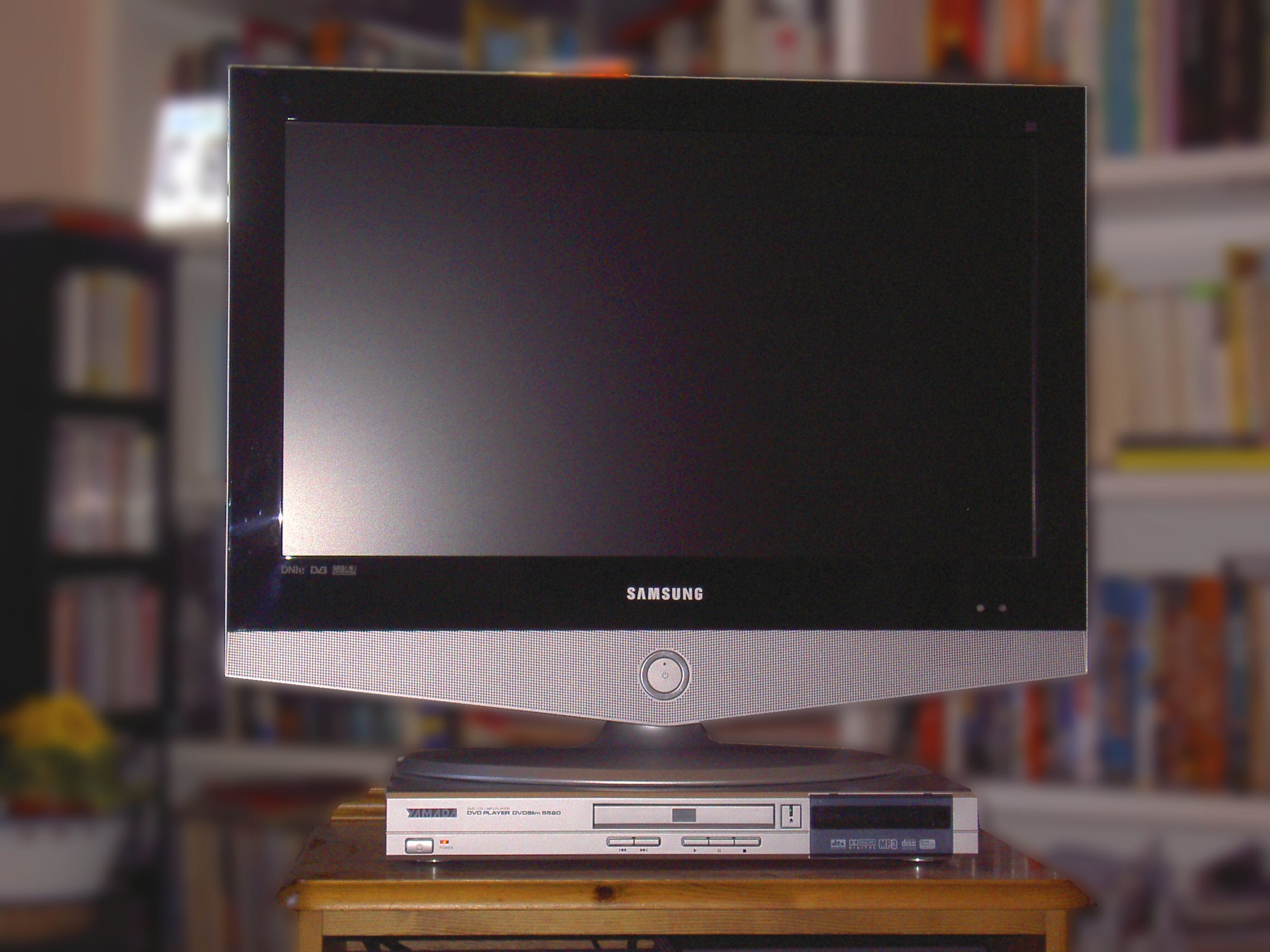
Contemporary early-2000s DVD player shown for era context, not a documented EVD unit
Era context only: a contemporary early-2000s DVD deck beside an LCD set. This is not a documented EVD unit. Genuine EVD examples include the Shinco EVD-8700 and related 2004-2008 alliance models with LSI Logic decoders. Photo: Ma8thew, Wikimedia Commons, CC BY-SA (via Openverse).

Documented genuine EVD models

Maker Model Year Price Evidence
Shinco 新科 EVD-8700 (also EVD8700) Jan 2004 ¥1,998 to ¥1,698 to ¥1,398 list / ¥998 promo First and for some time only EVD player on the market; EVD/DVD/SVCD/VCD/MP3/CD; CD-R/RW, JPEG; AC-3/DTS; component output
Shinco 新科 EVD8830 2004 (not retrieved) People’s Daily Online 2004 top ten innovative products
SVA 上广电 EVD388 2004 (not retrieved) Sohu 2004 most popular home appliances
Shinco 新科 EVD-327 c. 2007 ¥1,200 PjTime 2007 buyer’s guide of fifteen brands
Nine launch makers 11 models (numbers not found) Nov 2003 ~¥2,000 Amoi, BBK, Changhong, Malata, Nintaus, Shinco, SVA, Skyworth, Yuxing
Twenty relaunch makers 54 models (numbers not found) Dec 2006 ~¥700 Including Haier, Skyworth, TCL, Malata, Shinco, Amoi (counts vary by source)

E-World’s FAQ later listed brands available in stores as Shinco, SVA, Amoi, Malata, TCL, GIEC (杰科) and Kaigao (凯高), adding that Shinco had the largest output and was the easiest to buy, sold through Gome, Dazhong, Suning, Yongle and department-store counters, with one-year free repair and a repair card in every box. c114 records that in 2004 only Shinco and SVA actually put EVD on the market. Those are different dates; both are kept. The model number is written EVD-8700 (c114, Baidu) and EVD8700 (E-World FAQ); same player.

Chipsets

Vendor Evidence Assessment
LSI Logic (DoMiNo) First semiconductor supplier of HD EVD technology (EDN 2003); EE Times 2003 and 2006 say launch and shipping players used LSI; LSI 2004 boilerplate lists EVD; iSuppli 2006: only one chip company provides EVD chips Only confirmed EVD decoder source
LSI DoMiNo family DMN-8602, DMN-8603, DMN-8652, DMN-8653 documented in DVD-recorder SoCs; support MPEG-1/2/4, SD-to-HD upscaling, CSS/CPRM/CPPM/DES Which DoMiNo part sat in EVD players is not documented
Amlogic HVD chips; listed as EVD alliance technology provider in 2006 No evidence of an Amlogic EVD decoder
STMicroelectronics 2005 H.264 next-generation EVD letter of intent No product
Zoran, MediaTek, Sunplus, Sigma, Cheertek No evidence of EVD HD decoding Modern EVD-keyword players on these chips are DVD-only

LSI sold its consumer products business to Magnum Semiconductor in 2007, which may help explain why EVD chip supply ended around 2008. E-World marketing explained higher player prices by the need for an extremely powerful consumer chip, equivalent to a Pentium IV, because EVD computes five times the data of DVD. That is promotional language, not a measured FLOPS claim.

EVD-labelled DVD players on sale today

Current Chinese retail listings routinely put EVD in titles for ordinary DVD hardware. Examples from methodical retail searches include SAST PDVD-7026A, SA-299, SA-298 and SA-065; Amoi DVD-618; Qisheng QS-39; BBK home DVD units; Jinzheng home EVD players; Shinco EVD.SDP-1510 portable; and even GIEC BDP-G5300 / G5300PLUS 4K UHD Blu-ray players marketed with EVD keywords. None of these listings is evidence of EVD disc playback. They illustrate the naming trap: EVD became a marketing synonym for disc player rather than a format capability.

How to verify a genuine EVD player

  1. Date. Manufactured 2004-2008 (label, manual, warranty card). Post-2009 products labelled EVD are almost certainly DVD-only.
  2. Brand and model. Shinco EVD-8700, EVD8830, EVD-327 or SVA EVD388 are documented; other alliance brands (Amoi, Malata, TCL, GIEC, Kaigao, BBK, Changhong, Skyworth, Nintaus, Yuxing, Haier) produced EVD models whose numbers are not yet recorded.
  3. Decoder. Open the case and look for an LSI Logic media processor. Record the full part number; published identification of the EVD chip would close a research gap.
  4. Outputs. Component YPbPr HD output (and HDMI on later units). Composite/S-Video-only machines cannot deliver EVD HD.
  5. Manual. Should list EVD disc playback and HD output modes (1080i/720p) separately from DVD.
  6. Disc test. Play a commercial Jindian Global or Zhongkai EVD disc. An ordinary DVD player should refuse it.
  7. Menu. Genuine players often show an EVD logo at start-up or in the disc-type display.

Service and manuals

Every genuine EVD player shipped with a repair card and one year’s free repair through manufacturers’ regional service centres (E-World FAQ). No EVD player service manual, firmware image or schematic was found online in the research gathered for this series. Chinese repair forums and 家电维修 magazine archives remain the most promising next sources. Until a manual or board photo with a readable LSI part number surfaces, treat the DoMiNo family as the known silicon line and specific EVD SKUs as undocumented.

Collector field notes

Price history for the flagship Shinco EVD-8700 is unusually well documented: ¥1,998 at New Year 2004, ¥1,698 with the June 2004 Dazhong experience-hall push, then ¥1,398 list with promotions to ¥998 plus bundled HD discs. E-World called ¥998 the most stable post-launch price, a fall of about 55 percent. The December 2006 relaunch aimed at about ¥700, roughly DVD-player street pricing. HD-EVD announcements in 2008 floated about ¥1,000. Those numbers chart desperation as much as democratisation: each cut tried to solve soft demand without solving missing titles or missing HD televisions.

Retail availability claims also need dates attached. c114’s 2004-05 reporting (only Shinco and SVA selling) is not incompatible with E-World’s later FAQ list of seven brands in stores; the channel simply changed over time, and alliance membership never equalled shelf presence. Launch-day claims of eleven models from nine makers, and relaunch claims of about fifty-four players from about twenty makers, remain mostly unanchored by surviving model numbers. Photographing badges, rear-panel logos and main-board markings on any surviving unit is therefore historically useful, not only for personal collecting.

Finally, do not trust the word EVD on a modern carton. Keyword stuffing on JD, Suning and similar platforms has turned EVD into a synonym for “disc player” across DVD and even 4K UHD Blu-ray SKUs. The format test is always the commercial encrypted disc plus the LSI-era hardware window, never the product title string alone.

What a surviving unit can still teach

Because so few model numbers were published, any authenticated player is a primary source. Useful photographs include the front badge and model silk-screen, rear-panel connector set (especially component and any HDMI), the power-supply and main-board labels, and a clear shot of the media processor package. If the chip marks include an LSI or DoMiNo family string, publish the full part number; that would be the first widely circulated identification of the EVD decoder SKU. Pairing that with a successful play of a Jindian Global or Zhongkai title, and with the manual’s EVD/HD mode wording, is the gold-standard authentication path.

HD-EVD remains thinner in the record: 2008 announcements of 1080p output and ¥1,000 players exist, but without model lists or board photos the category should stay labelled announced rather than collected. Until those units surface with documentation, treat HD-EVD as a late marketing rename of the same red-laser programme rather than a second, well-attested hardware generation.


Sources


Further reading on historic video formats

If you want to learn more about historic video formats, get The History of Physical Video Formats from the Frontier by Stephen Driver on Amazon:

Blog CVD Guides Player Hardware
CVD Player Hardware: Launch Decks to DVD Hybrids

Three kinds of “CVD player”

China Video Disc (CVD) hardware is not one product class. A deck that “plays CVD” can mean three different things, and mixing them up produces bad buying advice and bad preservation notes. Dedicated CVD players shipped in the June-October 1998 launch window under the CVD name, built around C-Cube CVD decoders before the national Super VCD standard settled the market. Chaoji VCD / 超级VCD players from 1 November 1998 onward were required by SJ/T 11196 to play SVCD, CVD, VCD 2.0, VCD 1.1 and CD-DA. DVD players with explicit CVD listings followed in Chinese catalogues from late 1998; Western DVD decks that only advertise “SVCD” may or may not play CVD streams at 352-wide resolution.

No complete commercial model list survives for the first category. What follows is a register built from 1998 press, later product databases and community testing claims-not a manufacturer catalogue.

Launch-era machines (1998)

Attribute Detail
Decoder C-Cube CVD decoder (CVDx1 reported in contemporary chip coverage)
Mechanism Philips 2× (double-speed) with CD7 digital servo
Claimed resolution Up to 400 lines (makers); 350-400 in Jinzheng coverage
Audio 4 channels (two stereo pairs), karaoke-oriented
Subtitles 4 languages / 4 subtitle choices
Compatibility claims CVD, SVCD, VCD 1.0/1.1/2.0, CD, CD-i
Other functions P/N switching, disc preview, programmed play, interactive PBC
Street price About ¥1,600-1,800 (Shenghuo Shibao, 22 July 1998)
Bundles Free CVD discs with Jinzheng players; “several hundred” titles bundled across a dozen or so makers

Guangming Daily’s 3 November 1998 coverage and Jinzheng’s July 1998 article are the backbone for the mechanism and decoder picture. Shenghuo Shibao supplies the resolution, four-channel audio, four-subtitle and price claims. Jinzheng’s piece is also the only press source that has been read as naming specific dedicated models: the Jinzheng N100 and N300, advertised with “400 lines,” four audio channels, four subtitle languages and a Philips 2× mechanism. That model-name reading is not confirmed in every later retrieval of the same article’s comparison text, so the N100/N300 designations remain reported rather than fully cross-checked against a complete scan.

Brands confirmed selling CVD machines in 1998 include Aido and SAST (on sale in Beijing by 29 July 1998), Jinzheng (taking orders), and the five launch makers covered in Shanghai reporting (Wenzhai Bao, Shenghuo Shibao). Changhong, Malata and Amoi appear in the June 1998 Shanghai launch coverage; BBK is reported among the first batch in Jinzheng and later encyclopaedia summaries.

Chaoji VCD / Super VCD decks (late 1998-1999)

After 1 November 1998, CVD support was a compliance requirement for Chinese Super VCD players rather than a brand option. Shinco Super VCD machines used Shinco’s own SVD1811 MPEG-2 decoder from its “超越号” digital technology laboratory and were fitted with decryption components to read rivals’ discs during the compatibility war. SVCD-camp players in Guangming Daily’s November coverage used a Sony double-speed mechanism with digital servo and a decoder reported as jointly developed by ESS and Shinco.

Feature creep ran fast. Between October 1998 and July 1999, Super VCD decks added MP3 and MIDI playback, handheld models, recordable models, networking and language-learning 复读 (repeat) functions. By July 1999 single-disc players were reported below ¥800. No surviving model-by-model list for 1998-1999 Chaoji VCD players was recovered. The 1998 repair compilation 《影碟机维修实例999》(李玉全 ed.) lists period VCD models such as Malata N10 and N30, Aido IV-720 and Shinco VCD-10C; those numberings are leads for contemporary platform families, not proof that each unit was a CVD deck.

DVD players that list CVD

Player Maker Year / era CVD evidence
DVD2000 TCL 王牌 Oct 1998 Plays VCD, CVD and DVD
DVD-N9168 Jinzheng 金正 c. 2000s Lists CD/VCD/CVD/SVCD/DVCD/CD-R/DVD
D1800K Konka 康佳 c. 2000s Lists CD/VCD/CVD/SVCD/CD-R/DVD
DVD-N660 Jinzheng later Lists EVD, DVD, Super VCD, DVCD, CD, MP3 (CVD not named)
Shinco DVD line Shinco 新科 1998 All 16 lines converted to DVD; backward-compatible with SVCD
JVC XV-N series JVC 2000s Marketed “DVD / Super VCD / VCD / CD”; CVD not stated
Sampo DVE612 Sampo c. 2002 Recommended on VideoHelp for SVCD at high bitrates

PjTime buying guides make the general point that domestic Chinese DVD players supported far more disc types-including CVD-than imported examples such as the Sony DVP-S7000 and Toshiba SD-series units that played only CD, VCD and DVD. That domestic-vs-import gap matters when collectors assume “SVCD on the box” equals CVD playback.

Chipsets behind the labels

Vendor Parts CVD relevance Evidence
C-Cube Microsystems CL480/CL484/CL680 (VCD); CVD decoder (CVDx1); Chaoji VCD decoders; ZiVA (DVD) CVD sponsor; CVD-era decoders Strong (SEC filings)
ESS Technology SVCD decoder with Shinco Government SVCD side Moderate
Shinco lab SVD1811 MPEG-2 Shinco Super VCD players Moderate
Zoran, MediaTek, Sunplus, others Later generic DVD chipsets Many listed SVCD/CVD Weak: forum lore

SatStorm’s 2002 VideoHelp guide said CVD-capable standalones were mostly “made in southeast asia” and “using C-Cube’s microchips.” C-Cube reported in September 2000 that it was the first chip supplier to pass 10 million DVD chip shipments and claimed about 30% of the DVD silicon market in 1999. The launch CVD story is therefore as much a C-Cube silicon story as a brand-name story.

Model register (as known)

  • Jinzheng N100 / N300 – dedicated CVD players, reported from the July 1998 Jinzheng article (model names pending full-article confirmation).
  • Aido, SAST – unnamed dedicated CVD models on sale in Beijing, July 1998.
  • Changhong, Malata, Amoi – unnamed dedicated CVD models launched Shanghai, June 1998.
  • BBK – dedicated CVD, reported in first batch.
  • Shinco Super VCD (SVD1811) – Chaoji VCD / SVCD class.
  • TCL DVD2000, Jinzheng DVD-N9168, Konka D1800K – DVD with explicit CVD listing.

Period VCD models that may share platforms with CVD-era machines include Malata N10 and N30, Aido IV-720, Shinco VCD-10C and Changhong VD-3000.

Maker survival and manuals

Aido 爱多 collapsed in 1999-2000; no official service archive survives in the usual places. Jinzheng / Nintaus 金正 still sells DVD/EVD players on major Chinese retail sites and was founded 2 April 1997. SAST 先科, Malata 万利达, Amoi 夏新/厦新, Shinco 新科, Changhong 长虹 and BBK 步步高 all leave some modern retail footprint under the old brand or a successor. No dedicated CVD-player service manuals were found online. Chinese repair compilations such as 《影碟机维修实例999》(1998) and 家电维修 magazine archives remain the most promising paper trails.

Compatibility: conflicting community claims

Western DVD-player CVD success rates are anecdotal and do not agree. SatStorm wrote in 2002 that many US Region-1 standalones compatible with SVCD still do not play CVDs. A VideoHelp “CVD VS. DVD” thread claimed CVD on CD-R works with about 70% of PAL and about 30% of NTSC DVD players, sometimes needing header rewrite or 44.1 kHz audio-while another user in the same thread said they had tested hundreds of players and never found one that played SVCD but not CVD, and a third claimed all SVCD-compatible DVD players are required to play CVD regardless of region. AnandTech posts from 2006 cluster around “more than half the DVD players in the US will handle it” and roughly an 80% chance that an SVCD-capable player plays CVD. VideoHelp’s SVCD overview says most SVCD-capable standalones support CVD. All of those figures are kept as open disagreement; none is a laboratory result.

A practical test pattern used in community guides is a short 30-60 second burn at 352×480 or 352×576, CBR about 2,000 kbps, MP2 224 kbps at 44.1 kHz, authored as an SVCD image, with an otherwise identical 480-wide SVCD as control. Test CD-RW first, then CD-R: many early DVD players read only pressed discs, and CD-R reading is a separate capability from (S)VCD support. Check basic playback, scan, chapter skip, audio switching and both CVD-style and OGT subtitles. If the 480-wide control plays and the CVD does not, the player’s SVCD support is effectively Philips-only.

Known quirks include half-width or wrongly scaled pictures when sequence headers signal unexpected sizes; subtitles that appear in only one flavour; subtitle failures reported above about 1,800 kbps maximum video bitrate; 48 kHz audio on CD playing slow (Sony S560D cited); Nero “compliance check” passing streams that exceed SVCD peak rates; and 1998 “interference code” discs that fail on rival brands’ players. Hardware collecting for CVD therefore starts with naming the category-dedicated, Chaoji, or DVD-hybrid-then treating Western SVCD claims as hypotheses until a 352-wide test disc says otherwise.


Further reading on historic video formats

If you want to learn more about historic video formats, get The History of Physical Video Formats from the Frontier by Stephen Driver on Amazon:

Blog CBHD Guides Player Hardware
CBHD Player Hardware: Shinco and TCL

Two makers, six production models

Standalone CBHD players were made by Shinco (Jiangsu Shinco Electronic Group, 新科) and TCL. Six production models are normally documented. The hardware record also needs prototype and pre-production categories rather than a flat list of six. Memory-Tech’s March 2009 announcement said TCL, Shinco and Tsinghua Tongfang all had player products in development; Tongfang did not confirm a retail release.

Model Maker Class Price notes
CBHD-9100 Shinco Flagship / launch ¥2,580 with 15 discs; reviewed at ¥2,999; ¥1,599 by Jan 2010
CBHD-3800 Shinco Slim / mid-range ¥2,980 list (Yesky); ~¥1,800 in one secondary account
HD-2100 Shinco Wall-mount / entry compact ~¥1,200 (secondary); Yesky “暂无”
HD-3700U Shinco Hybrid satellite STB / player ~¥1,500
THBD-1008 TCL Launch model ~¥1,999; £259.99 UK
THBD-1038 TCL Second generation ~¥1,600 (secondary)

Typical features across the set: HDMI up to 1080p, multi-channel or stereo audio outputs, USB media playback, Linux-based firmware. Price and class figures for CBHD-3800, HD-2100, HD-3700U and THBD-1038 differ between primary Chinese list prices and secondary summaries; both are retained below where they conflict.

Shinco CBHD-9100

First model, spring 2009, best-documented unit. Shinco designed its own loader/mechanism without Toshiba kits, saying it cost less than Toshiba’s design. An AVSForum thread describes it as “likely” derived from the Toshiba HD-A35 (unconfirmed). Specs include AC 100-240 V, 42 W; 430 × 330 × 58 mm; 3.105 kg; video decode AVS-Video, VC-1, MPEG-4, AVC, JPEG; outputs 1080p/i, 720p, 480p via HDMI, component, S-video, composite; audio AVS-Audio, LPCM, DRA, Dolby AC-3 with coaxial and 5.1 analogue; disc compatibility CBHD, DVD, DVD±R/RW, VCD, CD, MP3, JPEG; front USB for TS/MP4/1080p files and external subtitles; CETC navigation; proprietary 4-6 modulation coding. Gemini adds brushed aluminium chassis and HDMI 1.3.

Launch package bundled 15 CBHD discs not sold separately, including The Warlords (投名状), The Island (逃出克隆岛) and Flood (水啸雾都). An importer reported 25 free discs in October 2009; ja.wikipedia records a 16-disc bundle; Suning Shanghai gave 10 free discs in April 2010. PConline published a 5-page review with 54 photos (5 July 2009). 电脑报 2009 No. 30 tested it on a TCL 46-inch TV over component, including USB 1080p and subtitle loading. Shinco built 2,000 units before Chinese New Year 2009. Officially on sale 22 May 2009 with Warner and China Record discs per PConline (31 May 2009).

Shinco CBHD-3800, HD-2100 and HD-3700U

CBHD-3800: slim/ultra-thin mid-range announced early 2010 / launched around December 2009 with HD-2100, forming a high/mid/low line with the 9100 (pjtime). Yesky guide price ¥2,980 with USB and HDMI. Secondary description: standard chassis, HDMI, composite/component, USB, about ¥1,800.

HD-2100: wall-mount (挂壁型) player launched with the 3800; secondary account calls it entry-level compact with basic HDMI/composite at about ¥1,200; Claude pass found no price.

HD-3700U: hybrid home-entertainment gateway. Rear UTI (Universal Terminal Interface) port-Chinese broadcast equivalent of CableCARD-accepted satellite or digital-cable modules. Custom media processor decoded AVS, DRA, MPEG-2, DVD-Video, EVD, HVD, SVCD, VCD, SACD and AVI from USB; about ¥1,500. Reported quirks: pause on native CBHD dropped frame sync (first-generation CETC bug), forcing hard stop and re-seek (~0.5 s skip); DVDs/VCDs/USB AVI paused normally. DRA bitstream over HDMI often failed to lock on Western AV receivers because descriptors did not identify DRA. Factory manual documented Ethernet network playback from remote shares. Relationship of a separately named Shinco HD-3700 CBHD-HiFi demonstrator (July 2010 Shanghai launch) to the HD-3700U is not established.

TCL THBD-1008 and THBD-1038

THBD-1008 launched April 2009. Documented chips: NEC EMMA3 with VR5701C 64-bit MIPS CPU; Anchor Bay ABT1018 (1080i→1080p); Silicon Image Sil9134CTU HDMI 1.3a transmitter; Spansion S29GL256N 32 MB NOR flash. Video: VC-1, H.264, MPEG-4, MPEG-2; 1080p/24. Audio: Dolby Digital, Digital Plus, TrueHD, PCM. Outputs: HDMI, component, composite, 2.0 analogue, optical. Under 40 W; 430 × 320 × 54 mm; ~3.165 kg. Plays CBHD and DVD. China bundle 15 discs; UK package 14. Setup menu “almost the same as Toshiba HD DVD.”

AVSForum material quoting TCL’s maintenance manual states it “is based on HD-A30, and the motherboard is no doubt from Toshiba,” with firmware and 220 V PSU changes. Internal photos raised A30 vs A35 confusion: one shot lacked analogue 5.1 (A30-like) while a motherboard photo showed 5.1 (A35-like)-possibly a reference photo. ZOL’s June 2009 review tested an ordinary commercial CBHD movie that loaded quickly and played continuously at 1080p. GBAX imported it to the UK in October 2009 at about £259.99 with fourteen movies-the first CBHD player sold overseas. TCL stopped selling CBHD players around late 2009. pjtime (17 Oct 2009) adds output modes through 1080p, programme playing time ≥135 minutes at 1080p, JPEG to 1920×1080, standby under 1 W.

THBD-1038: listed by Wikipedia/secondary sources as second generation with network integration, updated CETC engine and lower power at about ¥1,600; no primary Chinese source found in the dedicated 2026 pass.

Chipsets, optics and donors

Hardware chain: 405 nm laser → optical pickup → RF amplifier → servo DSP → modulation/channel decoder → system processor. CBHD needs dedicated FSM support at the servo/channel stage. Novatek NT90912 (FSM/ETM/EFM+/EFM) and NT90902 RF amp (~60 MHz) appear in patent CN102157185A. Chinese pickup patent CN101556807B and multi-format pickup CN201549222U, plus BD/CBHD freeform lens CN102682801B, document optical engineering. Toshiba HD DVD players used Broadcom (e.g. BCM7411) or NEC SoCs with hard-wired MPEG-2/VC-1/H.264 and Dolby/DTS/E-AC3 decoding.

Because THBD-1008 is HD-A30-derived and CBHD-9100 is reportedly HD-A35-derived, Toshiba HD-A30/A35 (and HD-A2/A3 family) are plausible donors for PSUs, loaders and possibly mainboard parts. No source names the CBHD pickup part number; Toshiba PHR-803T is the documented HD DVD pickup used in Xbox 360 HD DVD drives-plausible but unconfirmed for CBHD. Drive firmware would differ even with the same pickup because the channel must handle FSM 4-6 rather than ETM 8-12. Beyond AVSForum TCL service-manual excerpts, no downloadable 维修手册, Spansion dumps or Taobao CBHD-specific parts shops were found.

Prototypes and extensions

Shinco CBHD-9000 appears in May 2009 AVSForum user reports among launch models with photographs (possibly a pre-production designation). Tsinghua Tongfang CBHD-0002 was shown in 2008 and photographed in 2009 without confirmed retail. CBHD-3D and CBHD-HiFi products launched in 2010; one 3D title existed by July 2010; model numbers for the 3D player were not found. No evidence of CBHD products from Amoi, Skyworth, Changhong, Hisense, Malata or Giec; no PC drives or laptops found. Haier and BBK were alliance members. Pjtime’s 2010 index notes incompatibility problems between brands because production standards were not unified. Tencent (5 Jul 2010): about 4,000 blue-laser players a month in Beijing, of which about 150 were CBHD-almost all Shinco.

Manuals, websites and where documentation hides

No complete user manual, service manual or schematic for any CBHD player was found online in the dedicated 2026 search pass. Queries included CBHD-9100 and THBD-1008 说明书 / 维修手册 / 电路图 strings plus Toshiba HD-A30 manual searches. The highest-value surviving technical fragment remains AVSForum master-thread page 5, where a member posted TCL THBD-1008 maintenance-manual excerpts: a block diagram and a labelled motherboard photo with chip identities.

Wayback Machine captures of shinco.com (news pages on Warner support, Universal support and product launch, plus neighbouring product and service scripts), tcl.com product trees from 2009-2010, and chdia.org.cn are the next places to look. Toshiba HD-A30 owner and service manuals remain platform references because the THBD-1008 setup menu is almost the same as Toshiba HD DVD. Chinese repair libraries returned no CBHD hits in that pass but still deserve model-number retries. Second-hand boxed units on Xianyu and Kongfz often include printed manuals and warranty cards-ask sellers for photos before purchase.

Retail behaviour around the decks

ITmedia’s October 2009 Suning visit found a lone CBHD-9100 among many DVD players and one Sony Blu-ray unit. By April 2010 Suning Shanghai sold more than one hundred Shinco units a month with ten free discs. Shinco’s December 2009 New Year promotion pushed an entry-level player at ¥1,500 with ten to twenty-five free titles plus the 60th National Day parade disc. Marketing general manager 李正洋 said in 2010 that Shinco aimed for about 2,000 retail points through GOME and Suning. TCL had already exited CBHD sales by late 2009 per Tencent’s July 2010 survey. Baidu Baike notes Shinco claimed independent development of front-end servo and back-end decoding-consistent with the story that the 9100 loader was not a Toshiba kit.

Donor strategy in one paragraph: prefer Toshiba HD-A30 and HD-A35 family parts for THBD-1008 and possibly CBHD-9100 mechanical and electrical donors; photograph CBHD pickup labels before buying PHR-803T-class substitutes; expect firmware to differ even if optics look similar; budget trial-and-error; do not expect a cross-flash to invent FSM support. A modern preservation front-end may ultimately favour Novatek FSM-capable Chinese combo mechanisms over hoping an unmodified Western HD DVD drive will suffice.


Further reading on historic video formats

If you want to learn more about historic video formats, get The History of Physical Video Formats from the Frontier by Stephen Driver on Amazon: