
Blog EVD Guides Player Hardware
EVD Player Hardware: Genuine Decks versus EVD-Labelled DVD

Three things sold as EVD players

Collectors must keep three categories apart. Genuine EVD players (2004-2008) were built by alliance members on LSI Logic decoders and can play commercial EVD discs in HD over component (and later HDMI) outputs. Only a small number of model numbers are documented. HD-EVD players (2008) were announced with 1080p output at about ¥1,000; no model numbers were found. EVD-labelled DVD players (about 2008 to today) are ordinary DVD, portable DVD or even Blu-ray players whose listings use EVD as a keyword. They are the vast majority of anything found under EVD today and should be presumed unable to play EVD discs.
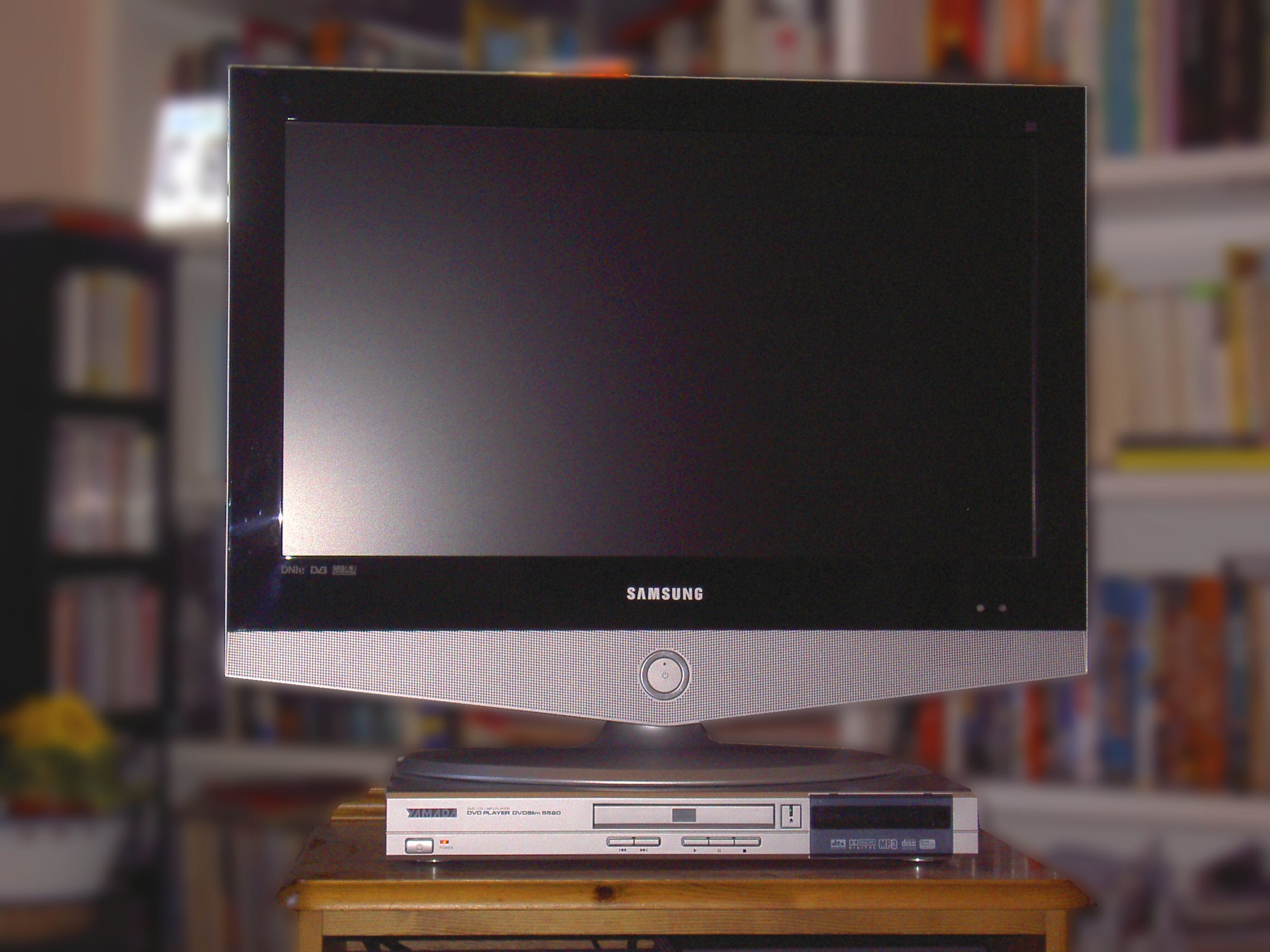
Contemporary early-2000s DVD player shown for era context, not a documented EVD unit
Era context only: a contemporary early-2000s DVD deck beside an LCD set. This is not a documented EVD unit. Genuine EVD examples include the Shinco EVD-8700 and related 2004-2008 alliance models with LSI Logic decoders. Photo: Ma8thew, Wikimedia Commons, CC BY-SA (via Openverse).

Documented genuine EVD models

Maker Model Year Price Evidence
Shinco 新科 EVD-8700 (also EVD8700) Jan 2004 ¥1,998 to ¥1,698 to ¥1,398 list / ¥998 promo First and for some time only EVD player on the market; EVD/DVD/SVCD/VCD/MP3/CD; CD-R/RW, JPEG; AC-3/DTS; component output
Shinco 新科 EVD8830 2004 (not retrieved) People’s Daily Online 2004 top ten innovative products
SVA 上广电 EVD388 2004 (not retrieved) Sohu 2004 most popular home appliances
Shinco 新科 EVD-327 c. 2007 ¥1,200 PjTime 2007 buyer’s guide of fifteen brands
Nine launch makers 11 models (numbers not found) Nov 2003 ~¥2,000 Amoi, BBK, Changhong, Malata, Nintaus, Shinco, SVA, Skyworth, Yuxing
Twenty relaunch makers 54 models (numbers not found) Dec 2006 ~¥700 Including Haier, Skyworth, TCL, Malata, Shinco, Amoi (counts vary by source)

E-World’s FAQ later listed brands available in stores as Shinco, SVA, Amoi, Malata, TCL, GIEC (杰科) and Kaigao (凯高), adding that Shinco had the largest output and was the easiest to buy, sold through Gome, Dazhong, Suning, Yongle and department-store counters, with one-year free repair and a repair card in every box. c114 records that in 2004 only Shinco and SVA actually put EVD on the market. Those are different dates; both are kept. The model number is written EVD-8700 (c114, Baidu) and EVD8700 (E-World FAQ); same player.

Chipsets

Vendor Evidence Assessment
LSI Logic (DoMiNo) First semiconductor supplier of HD EVD technology (EDN 2003); EE Times 2003 and 2006 say launch and shipping players used LSI; LSI 2004 boilerplate lists EVD; iSuppli 2006: only one chip company provides EVD chips Only confirmed EVD decoder source
LSI DoMiNo family DMN-8602, DMN-8603, DMN-8652, DMN-8653 documented in DVD-recorder SoCs; support MPEG-1/2/4, SD-to-HD upscaling, CSS/CPRM/CPPM/DES Which DoMiNo part sat in EVD players is not documented
Amlogic HVD chips; listed as EVD alliance technology provider in 2006 No evidence of an Amlogic EVD decoder
STMicroelectronics 2005 H.264 next-generation EVD letter of intent No product
Zoran, MediaTek, Sunplus, Sigma, Cheertek No evidence of EVD HD decoding Modern EVD-keyword players on these chips are DVD-only

LSI sold its consumer products business to Magnum Semiconductor in 2007, which may help explain why EVD chip supply ended around 2008. E-World marketing explained higher player prices by the need for an extremely powerful consumer chip, equivalent to a Pentium IV, because EVD computes five times the data of DVD. That is promotional language, not a measured FLOPS claim.

EVD-labelled DVD players on sale today

Current Chinese retail listings routinely put EVD in titles for ordinary DVD hardware. Examples from methodical retail searches include SAST PDVD-7026A, SA-299, SA-298 and SA-065; Amoi DVD-618; Qisheng QS-39; BBK home DVD units; Jinzheng home EVD players; Shinco EVD.SDP-1510 portable; and even GIEC BDP-G5300 / G5300PLUS 4K UHD Blu-ray players marketed with EVD keywords. None of these listings is evidence of EVD disc playback. They illustrate the naming trap: EVD became a marketing synonym for disc player rather than a format capability.

How to verify a genuine EVD player

  1. Date. Manufactured 2004-2008 (label, manual, warranty card). Post-2009 products labelled EVD are almost certainly DVD-only.
  2. Brand and model. Shinco EVD-8700, EVD8830, EVD-327 or SVA EVD388 are documented; other alliance brands (Amoi, Malata, TCL, GIEC, Kaigao, BBK, Changhong, Skyworth, Nintaus, Yuxing, Haier) produced EVD models whose numbers are not yet recorded.
  3. Decoder. Open the case and look for an LSI Logic media processor. Record the full part number; published identification of the EVD chip would close a research gap.
  4. Outputs. Component YPbPr HD output (and HDMI on later units). Composite/S-Video-only machines cannot deliver EVD HD.
  5. Manual. Should list EVD disc playback and HD output modes (1080i/720p) separately from DVD.
  6. Disc test. Play a commercial Jindian Global or Zhongkai EVD disc. An ordinary DVD player should refuse it.
  7. Menu. Genuine players often show an EVD logo at start-up or in the disc-type display.

Service and manuals

Every genuine EVD player shipped with a repair card and one year’s free repair through manufacturers’ regional service centres (E-World FAQ). No EVD player service manual, firmware image or schematic was found online in the research gathered for this series. Chinese repair forums and 家电维修 magazine archives remain the most promising next sources. Until a manual or board photo with a readable LSI part number surfaces, treat the DoMiNo family as the known silicon line and specific EVD SKUs as undocumented.

Collector field notes

Price history for the flagship Shinco EVD-8700 is unusually well documented: ¥1,998 at New Year 2004, ¥1,698 with the June 2004 Dazhong experience-hall push, then ¥1,398 list with promotions to ¥998 plus bundled HD discs. E-World called ¥998 the most stable post-launch price, a fall of about 55 percent. The December 2006 relaunch aimed at about ¥700, roughly DVD-player street pricing. HD-EVD announcements in 2008 floated about ¥1,000. Those numbers chart desperation as much as democratisation: each cut tried to solve soft demand without solving missing titles or missing HD televisions.

Retail availability claims also need dates attached. c114’s 2004-05 reporting (only Shinco and SVA selling) is not incompatible with E-World’s later FAQ list of seven brands in stores; the channel simply changed over time, and alliance membership never equalled shelf presence. Launch-day claims of eleven models from nine makers, and relaunch claims of about fifty-four players from about twenty makers, remain mostly unanchored by surviving model numbers. Photographing badges, rear-panel logos and main-board markings on any surviving unit is therefore historically useful, not only for personal collecting.

Finally, do not trust the word EVD on a modern carton. Keyword stuffing on JD, Suning and similar platforms has turned EVD into a synonym for “disc player” across DVD and even 4K UHD Blu-ray SKUs. The format test is always the commercial encrypted disc plus the LSI-era hardware window, never the product title string alone.

What a surviving unit can still teach

Because so few model numbers were published, any authenticated player is a primary source. Useful photographs include the front badge and model silk-screen, rear-panel connector set (especially component and any HDMI), the power-supply and main-board labels, and a clear shot of the media processor package. If the chip marks include an LSI or DoMiNo family string, publish the full part number; that would be the first widely circulated identification of the EVD decoder SKU. Pairing that with a successful play of a Jindian Global or Zhongkai title, and with the manual’s EVD/HD mode wording, is the gold-standard authentication path.

HD-EVD remains thinner in the record: 2008 announcements of 1080p output and ¥1,000 players exist, but without model lists or board photos the category should stay labelled announced rather than collected. Until those units surface with documentation, treat HD-EVD as a late marketing rename of the same red-laser programme rather than a second, well-attested hardware generation.


Sources


Further reading on historic video formats

If you want to learn more about historic video formats, get The History of Physical Video Formats from the Frontier by Stephen Driver on Amazon:
Blog EVD Format Overview Guides
Enhanced Versatile Disc: Format at a Glance

Enhanced Versatile Disc at a glance

Enhanced Versatile Disc (EVD) is China’s early-2000s attempt at a red-laser high-definition disc format on ordinary 120 mm DVD media. Developed by Beijing E-World Digital Technology Co., Ltd. (北京阜国数字技术有限公司) with Ministry of Information Industry backing, it launched at the Great Hall of the People on 18 November 2003, reached retail on 1 January 2004 with the Shinco EVD-8700, became electronics-industry recommended standard SJ/T 11299-2005 in February 2005, and faded after a December 2006 relaunch and a 2008 HD-EVD rename. It is not Blu-ray, not HD DVD, and not a new optical geometry: it is DVD-5 / DVD-9 discs plus proprietary encryption, ExAC/EAC audio, and HD video output from LSI Logic-based players.

120 mm DVD disc media; EVD uses the same physical disc form
EVD is physically a standard 120 mm DVD disc (two bonded 0.6 mm substrates, 650 nm red laser). Photo: William Hook, CC BY-SA, via Openverse and Flickr.

Identity card

Item Value
Format name Enhanced Versatile Disc (EVD)
Chinese names 增强型多媒体盘片系统; 新一代高密度数字激光视盘系统; 增强型通用光盘
Developer Beijing E-World Digital Technology Co., Ltd., founded 1999
Government backing MII, Ministry of Science and Technology, State Economic and Trade Commission
Research start 1999
Technical appraisal End of 2001 (E-World, alliance); early 2002 (PjTime/ZOL reprints)
Public launch 18 November 2003, Great Hall of the People, Beijing; 11 player models from 9 makers
First retail sales 1 January 2004; Shinco EVD-8700 at ¥1,998
MII HD test pass September 2004
Standard SJ/T 11299.1-4-2005; release/implementation 18 February 2005; MII notice 22/23 February 2005
Relaunch 6 December 2006 Beijing Declaration; ~54 players from ~20 makers; players ~¥700
HD-EVD 2008 upgrade: 1080p output claimed; players ~¥1,000; discs ¥15-30
Last new hardware 2008 (English Wikipedia)
Physical disc 120 mm DVD, 650 nm red laser, 4.7 GB (DVD-5) / 8.5 GB (DVD-9)
File system UDF (as DVD); directory tree not publicly documented
Video (contractual) On2 VP5 / VP6 licence, June 2003, US$2 per player
Video (reported in shipping players) MPEG-2 Main Profile @ High Level based scheme on LSI Logic decoders, with proprietary encryption (EE Times 2003 and 2006)
Video resolutions (claimed) 1920×1080i and 1280×720p; eight quality levels from VCD to HD
Audio ExAC / EAC (E-World); mono, stereo, 5.1
Subtitles 256-colour floating overlays with transparency, derived from Super VCD research
Encryption Proprietary; 128-bit key claimed; AACS migration announced 11 December 2005
Backward compatibility DVD, Super VCD, VCD, CD, MP3 (Shinco EVD-8700 also CD-R/RW, JPEG, AC-3/DTS)
Decoder chips LSI Logic (DoMiNo); iSuppli (2006): only one chip company provides EVD chips
Sales (reported) ~200,000 players in 2004; 300,000-400,000 in 2005; ~700,000 total by end 2006 (figures vary)
Disc catalogue 14 titles at Jindian Global’s first release; 100+ titles by 2006-2007
Successor CBHD (China Blue High-definition Disc), with Shinco switching camps

The single most important practical fact for collectors is that almost every player sold in China today with EVD in its listing is an ordinary DVD player. A genuine EVD player dates from 2004-2008, carries an LSI Logic decoder, and plays commercial Jindian or Zhongkai EVD discs that an ordinary DVD player rejects.

What sits on the disc

Physically, Chinese and Japanese sources agree that an EVD disc is simply a DVD disc: two bonded 0.6 mm polycarbonate substrates, 650 nm red laser, DVD-5 or DVD-9 capacity, UDF file system. Marketing claimed a two-hour HD movie on one disc (EDN 2003) or about 105 minutes of HD (Zhang Baoquan). No official EVD video bitrate was published; the arithmetic of those claims implies roughly 5-11 Mbit/s total, well below period broadcast HD MPEG-2 rates.

The video codec is the central open disagreement. EDN at launch said EVD would use On2’s VP5 and VP6. EE Times, in the same week and again in 2006, said shipping players used an MPEG-2 MP@HL-based scheme on LSI Logic chips, with On2 as an alternative option. On2’s own SEC filings show that the VP6 DSP port required for minimum royalties was never completed. Audio is E-World’s ExAC/EAC multichannel codec (SJ/T 11299.4), with English Wikipedia separately attributing EAC 2.0 to Coding Technologies; both origin stories are kept. Subtitles inherit Super VCD OGT research as 256-colour floating overlays. Protection in shipping titles was proprietary encryption; AACS was announced but no title is documented as having shipped with it.

How the numbers relate

EVD was sold as a way for Chinese DVD makers to escape foreign patent pools while offering HD on existing pressing lines. In practice every sellable EVD player also played DVD, so 6C/3C royalties remained. Player forecasts at launch ran to 1.8 million units in 2004; reported actuals were about 200,000 that year and a few hundred thousand more through 2006. Disc supply stayed thin: fourteen first titles from Jindian Global, then a slow climb past one hundred titles while pirate DVD compilations sold for a few yuan.

Relaunch counts for December 2006 disagree: Sina reported 18-19 makers and 51-52 models; AP, ZOL and English Wikipedia report 20 makers and 54 players at about ¥700. HD-EVD in 2008 promised 1080p output and ¥1,000 players; English Wikipedia dates the last new hardware to that year. Shinco, the main EVD producer, later moved to CBHD.

Quick codec and structure matrix

  • Physical: DVD-5 / DVD-9, 650 nm, UDF; same lines as DVD (TechRadar, Baidu) or more complex multilayer pressing (Sohu 2019). Both manufacturing claims kept.
  • Video: MPEG-2 MP@HL-based on shipping LSI players (EE Times); VP5/VP6 licensed but not ported to shipping DSPs (On2 SEC); AVS as declared future direction only.
  • Audio: ExAC / EAC, mono / stereo / 5.1; AC-3-to-EAC conversion tool existed for mastering.
  • Subtitles: 256-colour floating overlays from Super VCD research.
  • Protection: Proprietary encryption in shipping titles; AACS announced December 2005, not documented on discs.

What this glance deliberately excludes

Detailed royalty arithmetic, the On2 arbitration docket, rival HVD/HDV/FVD/VMD formats, full SJ/T part titles, and model-by-model hardware belong in later posts. This glance is the reference card: names, dates, physical parameters, the codec dispute, sales envelopes and the collector rule that modern EVD listings are almost always DVD players.

When later posts cite SJ/T 11299-2005, LSI Logic DoMiNo, Jindian Global, Shinco EVD-8700, Beijing Declaration or HD-EVD, they mean this parameter set. When they keep VP5/VP6 beside MPEG-2 MP@HL, they are preserving an open disagreement documented in contemporary trade press and SEC filings, not choosing a single winner.

Collector reminder

If a shopping listing, auction title or modern player faceplate says EVD, assume DVD until proven otherwise. Proof means a 2004-2008 manufacture date, an alliance brand with a documented or photographable LSI Logic decoder, HD component (or later HDMI) output, and preferably a successful play of a commercial Jindian or Zhongkai EVD title. Everything else in this series builds on that filter so that history, specifications and hardware posts are not accidentally describing today’s keyword-stuffed DVD decks.

Lineage in three steps

  1. White Book VCD boom and CVD / Super VCD (SJ/T 11196-1998) on CD media.
  2. EVD research (1999), launch (2003), SJ/T 11299-2005 on DVD media with red-laser HD claims.
  3. Collapse (2007-2008) and migration of key makers into CBHD on blue-laser HD DVD-derived technology.

EE Times in 2003 already called EVD a reincarnation of the VCD-to-Super-VCD strategy: embrace a foreign optical base, then push a Chinese system specification on top. The optical geometry stayed DVD; the fight was over codecs, royalties, content and whether HD TVs were common enough to make the difference visible.

Commercial life in numbers

Indicative player prices fell from ¥1,998 (January 2004) through ¥1,698 (June 2004) and promotional ¥998, to about ¥700 at the 2006 relaunch and about ¥1,000 for announced HD-EVD units. Disc prices stayed in the ¥18-28 band despite Zhang Baoquan’s 2005 promise of ¥3-5 discs. Sales figures disagree on whether 700,000 is cumulative installed base by late 2006 (EE Times) or a single-year claim (AFP quoting Zhang). Both strands are kept.

Alliance membership lists also disagree: E-World’s FAQ names Konka, Shinco, BBK, Amoi, Malata and SVA as shareholders; English Wikipedia and c114 give longer launch or nine-member sets. Treat those as open disagreements rather than a single canonical roster.

Reading this card against later posts

Later posts unpack history, technical specifications, related red-laser formats, standards and patents, and player hardware without repeating this card in full. The working vocabulary is: red-laser DVD media, SJ/T 11299, LSI Logic decoder, proprietary encryption, ExAC/EAC audio, Jindian/Zhongkai titles, and genuine hardware only from the 2004-2008 window.


Sources


Further reading on historic video formats

If you want to learn more about historic video formats, get The History of Physical Video Formats from the Frontier by Stephen Driver on Amazon: