
Blog EVD Format Overview Guides
Enhanced Versatile Disc: Format at a Glance

Enhanced Versatile Disc at a glance

Enhanced Versatile Disc (EVD) is China’s early-2000s attempt at a red-laser high-definition disc format on ordinary 120 mm DVD media. Developed by Beijing E-World Digital Technology Co., Ltd. (北京阜国数字技术有限公司) with Ministry of Information Industry backing, it launched at the Great Hall of the People on 18 November 2003, reached retail on 1 January 2004 with the Shinco EVD-8700, became electronics-industry recommended standard SJ/T 11299-2005 in February 2005, and faded after a December 2006 relaunch and a 2008 HD-EVD rename. It is not Blu-ray, not HD DVD, and not a new optical geometry: it is DVD-5 / DVD-9 discs plus proprietary encryption, ExAC/EAC audio, and HD video output from LSI Logic-based players.
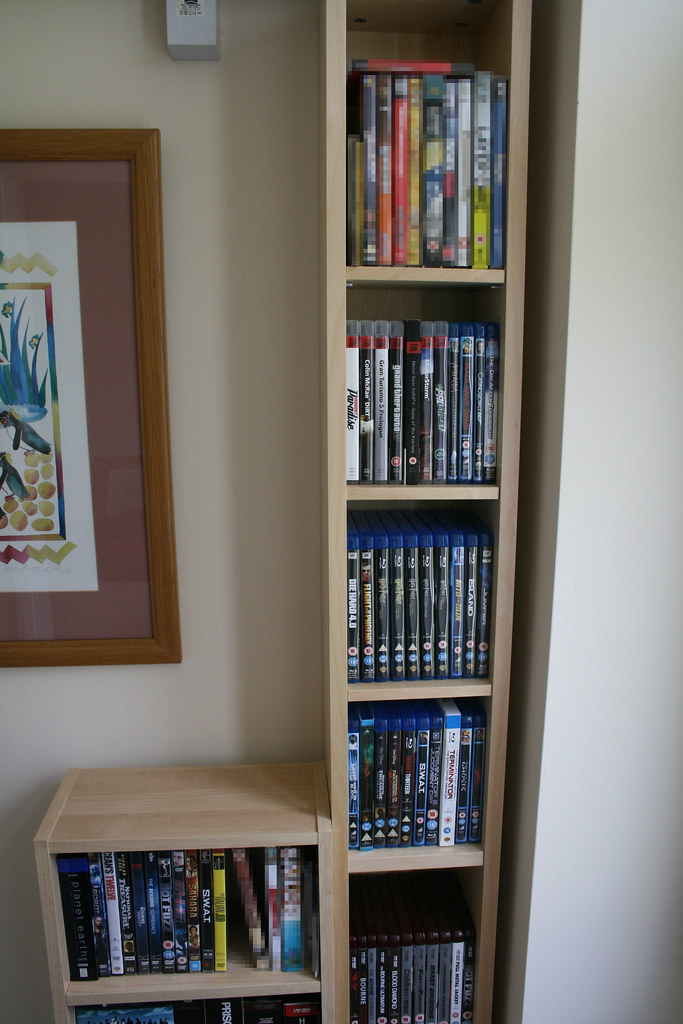
120 mm DVD disc media; EVD uses the same physical disc form
EVD is physically a standard 120 mm DVD disc (two bonded 0.6 mm substrates, 650 nm red laser). Photo: William Hook, CC BY-SA, via Openverse and Flickr.

Identity card

Item Value
Format name Enhanced Versatile Disc (EVD)
Chinese names 增强型多媒体盘片系统; 新一代高密度数字激光视盘系统; 增强型通用光盘
Developer Beijing E-World Digital Technology Co., Ltd., founded 1999
Government backing MII, Ministry of Science and Technology, State Economic and Trade Commission
Research start 1999
Technical appraisal End of 2001 (E-World, alliance); early 2002 (PjTime/ZOL reprints)
Public launch 18 November 2003, Great Hall of the People, Beijing; 11 player models from 9 makers
First retail sales 1 January 2004; Shinco EVD-8700 at ¥1,998
MII HD test pass September 2004
Standard SJ/T 11299.1-4-2005; release/implementation 18 February 2005; MII notice 22/23 February 2005
Relaunch 6 December 2006 Beijing Declaration; ~54 players from ~20 makers; players ~¥700
HD-EVD 2008 upgrade: 1080p output claimed; players ~¥1,000; discs ¥15-30
Last new hardware 2008 (English Wikipedia)
Physical disc 120 mm DVD, 650 nm red laser, 4.7 GB (DVD-5) / 8.5 GB (DVD-9)
File system UDF (as DVD); directory tree not publicly documented
Video (contractual) On2 VP5 / VP6 licence, June 2003, US$2 per player
Video (reported in shipping players) MPEG-2 Main Profile @ High Level based scheme on LSI Logic decoders, with proprietary encryption (EE Times 2003 and 2006)
Video resolutions (claimed) 1920×1080i and 1280×720p; eight quality levels from VCD to HD
Audio ExAC / EAC (E-World); mono, stereo, 5.1
Subtitles 256-colour floating overlays with transparency, derived from Super VCD research
Encryption Proprietary; 128-bit key claimed; AACS migration announced 11 December 2005
Backward compatibility DVD, Super VCD, VCD, CD, MP3 (Shinco EVD-8700 also CD-R/RW, JPEG, AC-3/DTS)
Decoder chips LSI Logic (DoMiNo); iSuppli (2006): only one chip company provides EVD chips
Sales (reported) ~200,000 players in 2004; 300,000-400,000 in 2005; ~700,000 total by end 2006 (figures vary)
Disc catalogue 14 titles at Jindian Global’s first release; 100+ titles by 2006-2007
Successor CBHD (China Blue High-definition Disc), with Shinco switching camps

The single most important practical fact for collectors is that almost every player sold in China today with EVD in its listing is an ordinary DVD player. A genuine EVD player dates from 2004-2008, carries an LSI Logic decoder, and plays commercial Jindian or Zhongkai EVD discs that an ordinary DVD player rejects.

What sits on the disc

Physically, Chinese and Japanese sources agree that an EVD disc is simply a DVD disc: two bonded 0.6 mm polycarbonate substrates, 650 nm red laser, DVD-5 or DVD-9 capacity, UDF file system. Marketing claimed a two-hour HD movie on one disc (EDN 2003) or about 105 minutes of HD (Zhang Baoquan). No official EVD video bitrate was published; the arithmetic of those claims implies roughly 5-11 Mbit/s total, well below period broadcast HD MPEG-2 rates.

The video codec is the central open disagreement. EDN at launch said EVD would use On2’s VP5 and VP6. EE Times, in the same week and again in 2006, said shipping players used an MPEG-2 MP@HL-based scheme on LSI Logic chips, with On2 as an alternative option. On2’s own SEC filings show that the VP6 DSP port required for minimum royalties was never completed. Audio is E-World’s ExAC/EAC multichannel codec (SJ/T 11299.4), with English Wikipedia separately attributing EAC 2.0 to Coding Technologies; both origin stories are kept. Subtitles inherit Super VCD OGT research as 256-colour floating overlays. Protection in shipping titles was proprietary encryption; AACS was announced but no title is documented as having shipped with it.

How the numbers relate

EVD was sold as a way for Chinese DVD makers to escape foreign patent pools while offering HD on existing pressing lines. In practice every sellable EVD player also played DVD, so 6C/3C royalties remained. Player forecasts at launch ran to 1.8 million units in 2004; reported actuals were about 200,000 that year and a few hundred thousand more through 2006. Disc supply stayed thin: fourteen first titles from Jindian Global, then a slow climb past one hundred titles while pirate DVD compilations sold for a few yuan.

Relaunch counts for December 2006 disagree: Sina reported 18-19 makers and 51-52 models; AP, ZOL and English Wikipedia report 20 makers and 54 players at about ¥700. HD-EVD in 2008 promised 1080p output and ¥1,000 players; English Wikipedia dates the last new hardware to that year. Shinco, the main EVD producer, later moved to CBHD.

Quick codec and structure matrix

  • Physical: DVD-5 / DVD-9, 650 nm, UDF; same lines as DVD (TechRadar, Baidu) or more complex multilayer pressing (Sohu 2019). Both manufacturing claims kept.
  • Video: MPEG-2 MP@HL-based on shipping LSI players (EE Times); VP5/VP6 licensed but not ported to shipping DSPs (On2 SEC); AVS as declared future direction only.
  • Audio: ExAC / EAC, mono / stereo / 5.1; AC-3-to-EAC conversion tool existed for mastering.
  • Subtitles: 256-colour floating overlays from Super VCD research.
  • Protection: Proprietary encryption in shipping titles; AACS announced December 2005, not documented on discs.

What this glance deliberately excludes

Detailed royalty arithmetic, the On2 arbitration docket, rival HVD/HDV/FVD/VMD formats, full SJ/T part titles, and model-by-model hardware belong in later posts. This glance is the reference card: names, dates, physical parameters, the codec dispute, sales envelopes and the collector rule that modern EVD listings are almost always DVD players.

When later posts cite SJ/T 11299-2005, LSI Logic DoMiNo, Jindian Global, Shinco EVD-8700, Beijing Declaration or HD-EVD, they mean this parameter set. When they keep VP5/VP6 beside MPEG-2 MP@HL, they are preserving an open disagreement documented in contemporary trade press and SEC filings, not choosing a single winner.

Collector reminder

If a shopping listing, auction title or modern player faceplate says EVD, assume DVD until proven otherwise. Proof means a 2004-2008 manufacture date, an alliance brand with a documented or photographable LSI Logic decoder, HD component (or later HDMI) output, and preferably a successful play of a commercial Jindian or Zhongkai EVD title. Everything else in this series builds on that filter so that history, specifications and hardware posts are not accidentally describing today’s keyword-stuffed DVD decks.

Lineage in three steps

  1. White Book VCD boom and CVD / Super VCD (SJ/T 11196-1998) on CD media.
  2. EVD research (1999), launch (2003), SJ/T 11299-2005 on DVD media with red-laser HD claims.
  3. Collapse (2007-2008) and migration of key makers into CBHD on blue-laser HD DVD-derived technology.

EE Times in 2003 already called EVD a reincarnation of the VCD-to-Super-VCD strategy: embrace a foreign optical base, then push a Chinese system specification on top. The optical geometry stayed DVD; the fight was over codecs, royalties, content and whether HD TVs were common enough to make the difference visible.

Commercial life in numbers

Indicative player prices fell from ¥1,998 (January 2004) through ¥1,698 (June 2004) and promotional ¥998, to about ¥700 at the 2006 relaunch and about ¥1,000 for announced HD-EVD units. Disc prices stayed in the ¥18-28 band despite Zhang Baoquan’s 2005 promise of ¥3-5 discs. Sales figures disagree on whether 700,000 is cumulative installed base by late 2006 (EE Times) or a single-year claim (AFP quoting Zhang). Both strands are kept.

Alliance membership lists also disagree: E-World’s FAQ names Konka, Shinco, BBK, Amoi, Malata and SVA as shareholders; English Wikipedia and c114 give longer launch or nine-member sets. Treat those as open disagreements rather than a single canonical roster.

Reading this card against later posts

Later posts unpack history, technical specifications, related red-laser formats, standards and patents, and player hardware without repeating this card in full. The working vocabulary is: red-laser DVD media, SJ/T 11299, LSI Logic decoder, proprietary encryption, ExAC/EAC audio, Jindian/Zhongkai titles, and genuine hardware only from the 2004-2008 window.


Sources


Further reading on historic video formats

If you want to learn more about historic video formats, get The History of Physical Video Formats from the Frontier by Stephen Driver on Amazon:

Blog CVD Format Overview Guides
China Video Disc: Format at a Glance

China Video Disc at a glance

China Video Disc (CVD) is the English name used in 1998 Chinese press for a short-lived CD-based video format, glossed as 中国视频视盘. It was backed by C-Cube Microsystems together with major Chinese VCD player makers, launched publicly in Shanghai on 9 June 1998, and within months absorbed into the Ministry of Information Industry’s Chaoji VCD (超级VCD / Super VCD) regime under SJ/T 11196-1998. As a distinct retail brand it lasted only from June 1998 into early 1999; as a disc type it survives inside that umbrella and, later, as a Western hobbyist encoding recipe.

Compact Disc - CVD uses standard 120 mm CD media
CVD is physically a standard 120 mm compact disc (CD-ROM XA / CD-i Bridge). Photo: Arun Kulshreshtha, Wikimedia Commons, CC BY-SA 3.0 (via Openverse).

Identity card

Item Value
Format name China Video Disc (CVD)
Chinese name 中国视频视盘 (1998 press); later under 超级VCD
Backer C-Cube Microsystems with Chinese VCD OEMs
Specification completed 1997 (Aho; Wikipedia)
Public launch 9 June 1998, Shanghai, with a jointly drafted industry standard
Absorbed into SJ/T 11196-1998 《超级VCD系统技术规范》, announced 29 September 1998, in force 1 November 1998
Commercial life as a distinct brand June 1998 to about early 1999
Primary market Mainland China (Shanghai, Wuhan and Beijing named in 1998 reports)
Physical basis Standard 120 mm CD, CD-ROM XA / CD-i Bridge, Mode 2 Form 2 for MPEG tracks
Drive speed 2× CD (Philips double-speed mechanism with CD7 digital servo, per Guangming Daily)
Video MPEG-2 (MP@ML), VBR
Resolution 352×480 (NTSC) / 352×576 (PAL), i.e. 1/2 D1; 1998 press also says CVD accommodated 2/3 D1 sources
Combined bitrate ceiling About 2.7-2.78 Mbps (2× CD Form 2 throughput)
Audio MPEG-1 Layer II, 44.1 kHz; up to 4 channels; a 5.1-channel CVD scheme was announced in 1998
Subtitles Up to 4 bitmap streams in the non-IEC “CVD-style” format
Menus / PBC SVCD-style playback control (selection lists, play lists, entry points)
Disc structure SVCD tree: /SVCD/INFO.SVD with system ID “SUPERVCD”, /MPEG2 (or /MPEGAV), /SEGMENT, /EXT
Playing time About 35-45 minutes per 74/80-minute disc at full rate; longer at reduced VBR averages
Decoder chips C-Cube CVD decoder (first sales Q2 1998; described as Chao Ji VCD-compliant in C-Cube’s Q3 1998 10-Q)
Installed base (reported) 300,000-600,000 players in the channel before the government SVCD spec was ready (Aho); “about 600,000” (Wikipedia)
Player price (1998) About ¥1,600-1,800; ¥500-600 above an equivalent VCD player

Launch-member lists differ by source. Wenzhai Bao (July 1998) names five-Aido 爱多, Changhong 长虹, SAST 先科, Malata 万利达 and Amoi 厦新-holding 65% of the domestic VCD player market. A Jinzheng Shenghuo Shibao article lists seven “first batch” makers including Jinzheng 金正 and BBK 步步高. Baidu Baike names SAST, Changhong, Aido and BBK for the 9 June launch; Western accounts add Nintaus/Jinzheng and “Xiamen Solid.” All lists are kept as open disagreements.

What sits on the disc

Video is MPEG-2 Main Profile at Main Level with variable bitrate. The practical definition used by Western tools and guides is half-D1: 352×480 at 29.97 fps for NTSC and 352×576 at 25 fps for PAL. That width is a legal DVD-Video resolution, which is why later hobbyists could move CVD video to DVD without re-encoding video-only the 44.1 kHz audio must be resampled to 48 kHz. Audio is MPEG-1 Layer II at 44.1 kHz, typically around 224 kbps, with up to two stereo pairs or four mono tracks marketed as four language choices. Bitmap overlay subtitles use a non-IEC “CVD-style” layout associated with CVD and EnReach I-Author, not the Philips OGT format later written into SVCD tooling. Playback control follows the SVCD tree of play lists, selection lists and entry points.

The single most important practical fact for collectors and rippers is that a CVD disc cannot be told apart from an SVCD by its file system alone. Both carry the INFO.SVD system ID “SUPERVCD”. The reliable test is the video width: 352 pixels for CVD, 480 for SVCD. GNU VCDImager’s documentation lists “SUPERVCD” as the shared system ID for SVCD, XVCD and CVD, with “HQ-VCD” reserved for the Video CD Consortium’s HQ-VCD variant.

How the numbers relate

CVD is not a new optical geometry. It is ordinary 120 mm CD pressed or burned as CD-ROM XA / CD-i Bridge: Mode 2 Form 1 for the ISO 9660 metadata track, Mode 2 Form 2 for MPEG programme streams. Form 2 sectors carry 2,324 bytes of user data. At 2× (150 sectors per second) that yields roughly 2.79 Mbps of raw throughput-the ceiling usually quoted as about 2.7 Mbps or 2,778 kbps for combined audio and video. At full rate an 80-minute blank holds about forty minutes of programme after ISO overhead and gaps; a 74-minute blank is nearer thirty-seven minutes. Longer titles need lower average VBR rates, commonly in the 1.5-2.0 Mbps band for sixty to eighty minutes of content.

Where CVD diverges from White Book VCD is the move from MPEG-1 at quarter-D1 (352×240/288) to MPEG-2 at half-D1, with SVCD-style menus and multi-stream audio/subtitles. Where it diverges from government/Philips SVCD is mainly horizontal resolution and subtitle format: 352-wide video and CVD-style bitmaps versus 480-wide video and OGT. Guangming Daily’s 3 November 1998 comparison, written after SJ/T 11196 took effect, stated that CVD and SVCD were identical in physical and file format and that CVD suited both 1/2 D1 and 2/3 D1 sources while SVCD suited 2/3 D1 only. Western sources still define CVD by the 352-pixel width. That disagreement is left open.

Market envelope in one paragraph

By mid-1998 China’s VCD industry was enormous: secondary sources put 1998 player sales near fourteen million units at the peak, with cumulative installed bases in the tens of millions. CVD launched into that channel at a ¥500-600 premium over VCD and well below contemporary DVD street prices of about ¥3,200-4,000. Contemporary reports said CVD was already selling quickly in Shanghai and Wuhan, with Aido and SAST machines on Beijing shelves and Jinzheng taking advance orders. Aho estimates 300,000-600,000 CVD players in distribution before the government SVCD text was ready; Wikipedia repeats “about 600,000.” Neither figure cites primary audited data. C-Cube booked first CVD decoder sales in Q2 1998 and, by its Q3 1998 10-Q, was describing the same silicon as compliant with the new Chao Ji VCD standard.

Quick codec and structure matrix

  • Video: MPEG-2 MP@ML, VBR; 352×480 (NTSC) / 352×576 (PAL); practical max around 2,516-2,600 kbps.
  • Audio: MPEG-1 Layer II, 44.1 kHz; up to 4 channels; 5.1 scheme announced but not the mass-market default.
  • Subtitles: Up to 4 CVD-style bitmap streams (not IEC 62107 OGT).
  • Navigation: SVCD-style PBC under /SVCD with INFO.SVD system ID “SUPERVCD”.
  • Protection: No CSS/region/Macrovision in the format; 1998-1999 “interference codes” were rival-locking tactics, not anti-piracy DRM.

What this glance deliberately excludes

Detailed timelines of the VCD boom, the MII-ESS SVCD programme, HQ-VCD politics, patents, firmware and catalogues belong in later posts. This glance is the reference card: names, dates, physical parameters, codecs, SUPERVCD identity, launch-maker disagreements and installed-base claims.

When later posts cite “352×480/576,” “SUPERVCD,” “2.7 Mbps,” “SJ/T 11196-1998,” “Chaoji VCD” or “C-Cube CVD decoder,” they mean this parameter set. When they name Aido, Changhong, SAST, Malata, Amoi, Jinzheng or BBK, they mean the documented 1998 launch and first-batch sets.

Lineage in three steps

  1. White Book VCD boom in China (1993-1998) and C-Cube’s MPEG decoder dominance.
  2. CVD specification (1997) and Shanghai public launch (9 June 1998).
  3. SJ/T 11196-1998 Chaoji VCD compromise (announced 29 September, effective 1 November 1998), folding CVD into Super VCD player requirements.

Discs were still called “CVD” after Chaoji branding; Western hobbyists later reused the name for half-D1 MPEG-2 on CD-R. Treat those as one lineage with renaming and a second life as an encoding recipe. The physical geometry stayed CD; the fight was over who set the next MPEG-2-on-CD standard for China’s installed base of mechanisms and pressing plants.

Commercial life in numbers

Retail shelves saw CVD players from June 1998. Indicative prices put VCD around ¥1,000-1,100, CVD around ¥1,600-1,800 and DVD around ¥3,200-4,000, with CVD discs costing about the same to press as VCD. Guangming Daily (November 1998) reported several hundred bundled titles, thousands of discs from nearly twenty publishers, and a ¥200 million “CVD 2000 project”; SVCD makers were said to be releasing nearly 100 titles by year end-press claims, not audited counts.

Installed-base reporting is noisy. Aho’s 300,000-600,000 range (Wikipedia’s “about 600,000”) lacks primary audited data. Wenzhai Bao’s 65% figure is the launch makers’ share of the overall VCD player market, not CVD’s share. Baidu Baike’s claim that 1998 Super VCD sales already equalled VCD conflicts with retrospectives that treat 1998 as the VCD peak and mid-1999 as DVD’s rise. Both strands are kept.

Modern authoring note

No mainstream tool offers a native CVD disc type except DeVeDe. Practical builds follow non-standard SVCD authoring (vcdimager -t svcd, mplex -f 5, ffmpeg SVCD-style streams at 352-wide). The disc still presents as SUPERVCD; only encoded width marks it as CVD.

Reading this card against later posts

When later posts cite half-D1 MPEG-2, SUPERVCD, SJ/T 11196-1998 / Chaoji VCD, or C-Cube’s Q2-to-Q3 1998 wording shift from “China Video Disc (CVD) platform” to “Chao Ji VCD standard,” they use this card’s vocabulary. The remaining posts unpack history, specifications, related formats, standards and patents without repeating it in full.


Further reading on historic video formats

If you want to learn more about historic video formats, get The History of Physical Video Formats from the Frontier by Stephen Driver on Amazon:

Blog CBHD Format Overview Guides
China Blue High-Definition Disc: Format at a Glance

China Blue High-Definition Disc at a glance

China Blue High-Definition Disc (CBHD) is the English commercial name for the format Chinese sources call 中国蓝光高清光盘, shortened to 中国蓝光. Earlier publicity used CH-DVD / China High Definition DVD and the DVD Forum logo name “HD DVD China.” Developers were the Optical Memory National Engineering Research Center (OMNERC, 清华大学光盘国家工程研究中心) at Tsinghua University together with the China Electronics Technology Group Corporation (CETC) 3rd Research Institute (中国电子科技集团第三研究所).

Identity card

Item Value
Proposal to DVD Forum WG-11 27 July 2005
Public announcement (as CH-DVD) 7 September 2007
Retail / official commercial launch April 2009 / 22 April 2009
Commercial life Approximately 2009 to 2011 / early 2010s
Primary market Mainland China (limited UK import via GBAX, 2009)
Physical basis HD DVD / DVD optical architecture, 2 × 0.6 mm bonded substrates
Disc diameter 120 mm
Capacity 15 GB single layer, 30 GB dual layer
Laser / NA 405 nm blue-violet / 0.65
Track pitch / minimum pit 0.40 μm / 0.204 μm
Modulation 4-6 FSM (replacing HD DVD’s 8-12 ETM)
1× transfer rate Approximately 36.55 Mbps
Maximum video bitrate (reported) 28 Mbps
File system UDF
Maximum resolution 1920 × 1080 (1080p)
Navigation CETC navigation (replacing HD DVD Advanced Content / HDi)

The archived official CHDA technical page is the source for the pit length, track pitch and numerical-aperture figures that later summaries often omit. It states that CBHD kept the 12 cm disc and used 405 nm light with NA 0.65, reducing pit length to 0.204 μm and track pitch to 0.4 μm.

What sits on the disc

Video codecs listed for the format are AVS (GB/T 20090.2), H.264/AVC, VC-1 and MPEG-2; MPEG-4 also appears on player lists. Audio codecs include AVS Audio, DRA (GB/T 22726), Dolby AC-3 and LPCM; the TCL THBD-1008 additionally lists Dolby Digital Plus and TrueHD. Copy protection split by content origin: DKAA for domestic titles, AACS for international titles. In 2010 the alliance also unveiled CBHD-3D and CBHD-HiFi profile extensions.

Commercial players normally documented as production models are six units: Shinco CBHD-9100, CBHD-3800, HD-2100 and HD-3700U, plus TCL THBD-1008 and THBD-1038. Prototypes and pre-production machines sat around that commercial set. Catalogue size claims cluster around about 100 titles by December 2009 to mid-2010, with one early-2010 report citing about 150; a promised 1,000 titles for 2010 was never reached.

How the numbers relate

Capacity, laser wavelength and cover-layer thickness place CBHD next to HD DVD rather than Blu-ray. Single-layer 15 GB and dual-layer 30 GB match the HD DVD envelope. The 0.6 mm bonded-substrate stack is the same family of DVD-like geometry that Chinese replication plants already knew how to make. Blu-ray’s 0.1 mm cover and 0.85 NA optics were deliberately not adopted.

Where CBHD diverges from a simple HD DVD rebadge is the channel and application stack. Replacing 8-12 ETM with 4-6 FSM changes the physical channel coding. Replacing Advanced Content with CETC navigation changes menus and interactivity. Mandating AVS and DRA (alongside legacy Western codecs on players) and pairing DKAA with AACS changes the intellectual-property and DRM profile. Those four layers-modulation, navigation, codecs, protection-are the short definition of the format beyond the capacity table.

Transfer rates and video ceiling

A 1× rate near 36.55 Mbps and a reported maximum video bitrate of 28 Mbps are reconstruction-relevant numbers. They show that CBHD is not “HD video burned onto a DVD.” The physical channel is genuine high-density blue-laser optical media. Average commercial encodes discussed elsewhere in this research cluster in the 12-18 Mbps range for 1080p, leaving headroom under the 28 Mbps ceiling for peaks and multiplexed audio.

Market envelope in one paragraph

Development started with a July 2005 proposal while HD DVD was still an active international format. Public CH-DVD announcement and CHDA founding followed in September 2007. Toshiba ended HD DVD in February 2008; Chinese work continued under MIIT backing and commercial branding as CBHD. Retail players and discs reached Chinese stores in April 2009 at player prices around ¥2,000 and disc prices initially ¥50-70. Limited overseas retail appeared when GBAX imported the TCL THBD-1008 into the United Kingdom in October 2009. By mid-2010 the title count had stalled near the low hundreds against a thin hardware base; by 2011-2012 replication had effectively ended.

Quick codec and protection matrix

  • Video: AVS (national GB/T 20090.2), H.264/AVC, VC-1, MPEG-2; MPEG-4 listed on hardware.
  • Audio: AVS Audio, DRA, Dolby AC-3, LPCM; Dolby Digital Plus / TrueHD on TCL THBD-1008.
  • DRM: DKAA domestic; AACS international.
  • Navigation: CETC (not HDi / Advanced Content).
  • Extensions: CBHD-3D and CBHD-HiFi (2010).

What this glance deliberately excludes

Detailed timelines, patent numbers, authoring chains, firmware debates and catalogue title lists belong in later chapters of this series. The glance is the fixed reference card: names, dates, physical parameters from the CHDA technical page, codec and DRM labels, the six production player models, and the catalogue-size claims that contemporary reporting actually made. Use it as the index into the longer research posts rather than as a substitute for them.

When later posts cite “15/30 GB,” “4-6 FSM,” “NA 0.65,” “0.204 μm pits,” “0.40 μm track pitch,” “36.55 Mbps 1×,” or “28 Mbps max video,” they are referring to the same CHDA-backed parameter set summarised here. When they name Shinco CBHD-9100, CBHD-3800, HD-2100, HD-3700U or TCL THBD-1008 / THBD-1038, they are referring to the documented commercial hardware set, not to an open-ended list of brands.

Lineage in three steps

  1. Chinese HD DVD proposal to DVD Forum WG-11 (2005).
  2. CH-DVD announcement and CHDA founding (2007).
  3. Commercial CBHD branding and April 2009 retail launch.

Publications sometimes kept calling the format CH-DVD after CBHD branding appeared. Treat that as one lineage with renaming, not as three unrelated disc formats. The physical geometry stayed HD DVD-like; the Chinese team’s work concentrated on the layers that carried licensing cost and domestic-standard control.

Commercial life in numbers

Retail shelves saw players from April 2009. The official commercial launch date recorded in industry timelines is 22 April 2009. Shinco had already built 2,000 CBHD-9100 units before Chinese New Year that year. Player street prices clustered near ¥2,000 at launch-about forty percent below contemporary Blu-ray decks in mainland China-then fell: the CBHD-9100 appeared around ¥1,599 in Guangzhou by January 2010. Disc prices opened at ¥50-70 for Warner launch titles, drifted toward ¥25-30 as the format fought piracy, and were reported online near ¥28 by 2010.

Title-count reporting is noisy. Japanese Wikipedia notes 100 titles reached by 21 December 2009. A Guangzhou report in January 2010 put CBHD at about 150 titles against 1,800 Blu-ray titles and estimated about 50,000 CBHD players sold nationwide. Alliance messaging at the September 2009 Guangzhou conference still projected 1,000 titles and a million players for 2010; those targets were not met. Mid-2010 Tencent coverage still sat near about 100 titles with a single 3D title in existence.

Hardware set, named once

Only two brands shipped commercial players: Shinco and TCL. The six production designations used throughout this series are Shinco CBHD-9100 (flagship), CBHD-3800 (slim mid-range), HD-2100 (wall-mount/entry), HD-3700U (hybrid UTI/network player), TCL THBD-1008 (Toshiba HD-A30-derived launch model, also sold in the UK by GBAX at about £259.99) and TCL THBD-1038 (second-generation listing). Prototypes such as Tongfang’s CBHD-0002 and pre-production Shinco CBHD-9000 listings appear in forum photography but are not counted as the commercial six. No PC optical drives or laptops with CBHD branding were found in the research passes.

Protection and region notes

Domestic Chinese films used DKAA; international films used AACS. Patent-sharing language described “AACS+DKAA,” and the AACS consortium had interim CBHD specification documents as early as 2007. Region coding is poorly attested: one pass treats it as undocumented (HD DVD itself was region-free); another states discs were region-locked to China with no US or Europe editions. Packaging used black Blu-ray-size keep-cases originally associated with HD-VMD tooling, carrying a blue CBHD logo; the DVD Forum’s separate “HD DVD China” logo had been approved in November 2007.

Extensions that arrived late

On 2 July 2010 CHDA launched CBHD-3D products in Beijing and unveiled CBHD-HiFi. HiFi used dual-layer 30 GB capacity for multi-channel LPCM up to 24-bit/192 kHz over secure HDMI. By early July 2010 only one 3D title was known to exist; Guangzhou Asian Games ceremonies were planned for 3D release. These extensions did not reverse the retail decline that CMM data already showed from the second quarter of 2010.

Reading this card against later posts

When a later post cites Modulation 4-6 FSM, it is pointing at the channel-coding change that blocks naïve HD DVD firmware hacks. When it cites CETC, it means the navigation replacement for Advanced Content/HDi. When it cites AVS and DRA, remember that early 2009 discs may still have used VC-1 or AVC because China Record lacked an AVS encoder at launch. When it cites DKAA versus AACS, treat domestic and international discs as two preservation problems. The glance table is the shared vocabulary; the remaining thirteen posts unpack history, physics, codecs, patents, players, PC paths, firmware, authoring, catalogue, sourcing, community archives and open questions without repeating this card in full.


Further reading on historic video formats

If you want to learn more about historic video formats, get The History of Physical Video Formats from the Frontier by Stephen Driver on Amazon: